A technical buyer guide comparing 3D puff embroidery, loopback chenille towel embroidery, and felt applique for custom streetwear hoodies and jackets
In contemporary menswear and streetwear branding, chest and back graphics serve as the primary tactile indicator of retail value. While direct screen printing remains the industry baseline, luxury streetwear brands and varsity-inspired labels increasingly utilize dimensional embroidery techniques—specifically 3D Puff Embroidery, Towel (Chenille) Embroidery, and Felt Applique—to command retail price points between $95 and $220+.
However, fashion founders and apparel product managers face technical challenges when translating digital artwork into stitched physical garments: which embroidery method best preserves sharp typography, what minimum fabric GSM is required to prevent puckering and needle cut, and how do production costs compare across small batches?
Specifying the wrong stitch technique can ruin a high-end collection—resulting in bullet-hard stiff chest panels, unravelled chenille loops after laundry, or distorted lettering. Mastering these methods requires an understanding of needle mechanics, backing stabilizers, and digitizing density.
Bayeeclothing provides in-house multi-head Tajima embroidery, chenille looping, and laser-cut applique manufacturing, engineered by 7 senior pattern designers (20+ years of tailoring experience) with a flexible 30-piece MOQ and rapid 3–5 day sample turnaround. This guide delivers a technical comparison of the three dominant premium logo techniques.
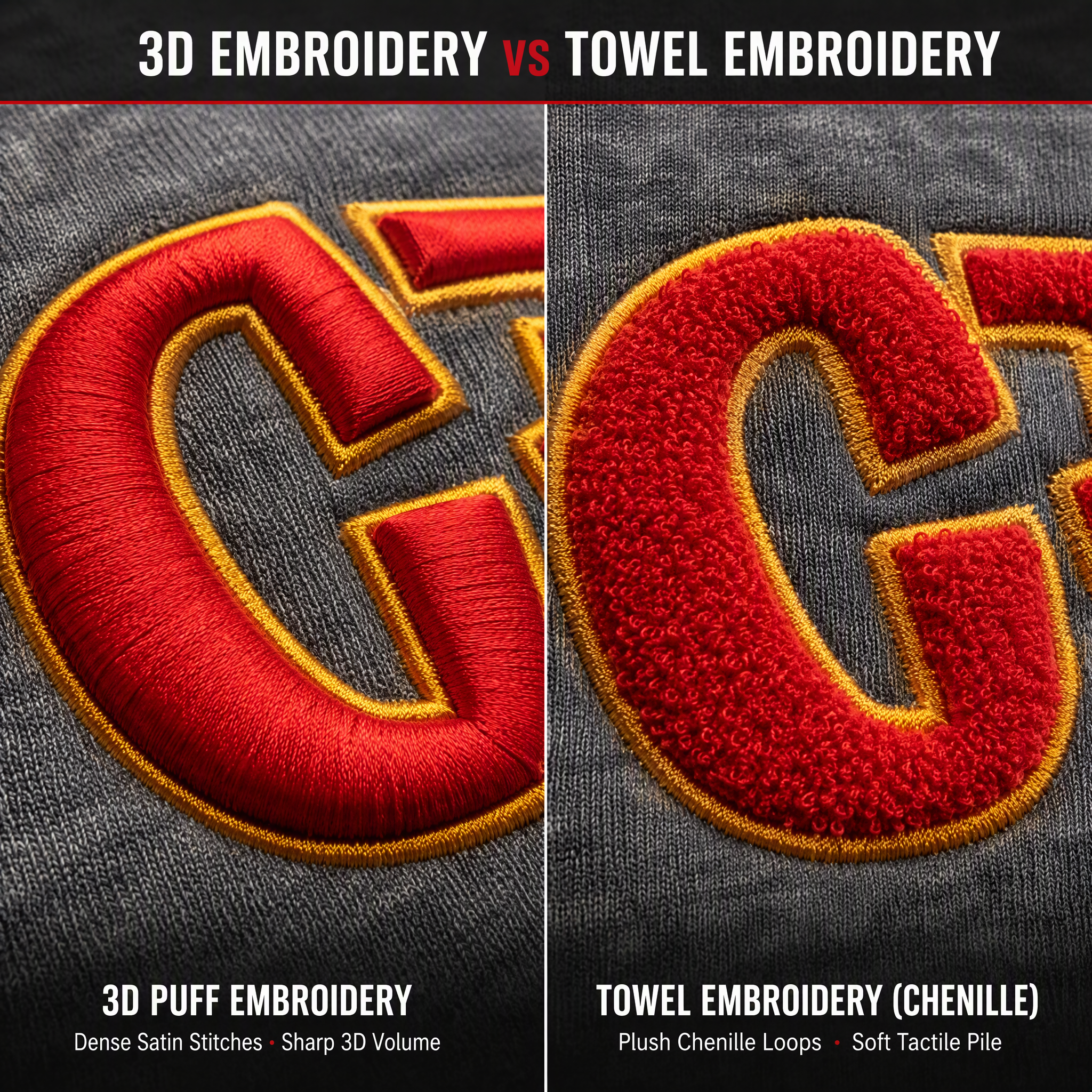
1. Quick comparison: 3D puff vs towel (chenille) vs applique
| Evaluation Factor | 3D Puff Embroidery | Towel (Chenille) Embroidery | Felt / Twill Applique |
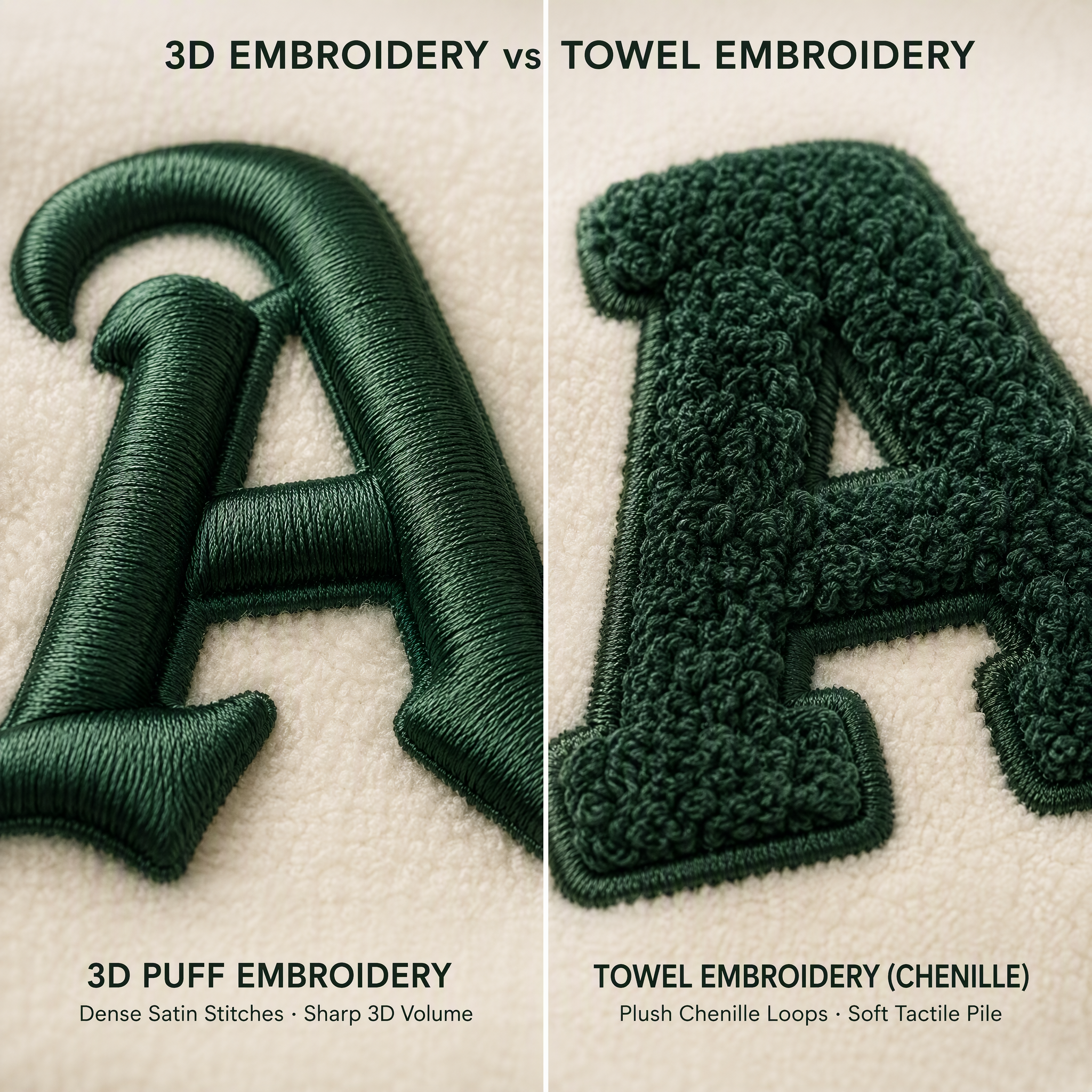
| Visual Texture | Crisp, geometric, raised rubberized relief (3–5mm elevation) | Soft, fuzzy, vintage collegiate carpet-loop texture | Layered vintage varsity aesthetic with clean satin stitched borders |
| Best Graphic Type | Bold sans-serif typography, block initials, clean geometric logos | Large mascot shapes, oversized vintage college letters (A–Z) | Oversized arch chest lettering, massive back-panel graphic shields |
| Minimum Line Weight | 4 mm minimum column width to encapsulate 3D EVA foam | 6 mm minimum stroke width for yarn loops to bloom properly | 8 mm minimum width to allow clean laser cutting and satin borders |
| Weight on Garment | High density stitches; can feel rigid on large surface areas | Lightweight and plush; adds texture without stiffening the chest | Extremely lightweight; fabric replaces millions of individual stitches |
| Recommended Fabric GSM | Heavyweight only: 380–500 GSM fleece, canvas, wool jackets | Medium to heavyweight: 300–450 GSM French terry & fleece | Universal: 240–500 GSM tees, French terry, hoodies, jackets |
| Wash Durability | Exceptional (dense satin polyester thread encapsulates foam) | High (requires gentle wash cycle to prevent loop snags) | Maximum (laser-cut twill/felt withstands heavy industrial wash) |
| Relative Cost (Small Batch) | Moderate (dependent on total stitch count) | Moderate-High (specialized chenille looping machine setup) | Most Cost-Effective for Large Graphics (replaces heavy stitch count) |
2. Technical deep-dive: Understanding each method
[ Structural Cross-Section ]
1. 3D Puff Embroidery ──> [ Satin Thread Overlock ] ──> [ High-Density EVA Foam (3mm) ] ──> [ Heavy Fleece ]
2. Towel (Chenille) ──> [ Wool/Acrylic Yarn Loopback ] ──> [ Felt Base Layer ] ──> [ Heavy Terry / Fleece ]
3. Applique Patchwork ──> [ Border Satin Stitch ] ──> [ Pre-Cut Wool/Twill Fabric ] ──> [ Any Garment Base ]
Technique 1: 3D Puff (High-Density) Embroidery
How It Works:
- ● A sheet of high-density EVA foam (typically 2.5mm to 4.0mm thick) is placed on top of the garment. The embroidery needle perforates the foam with heavy, high-density satin stitches, completely wrapping the foam underneath. The excess foam is then cleanly torn away, leaving a three-dimensional raised letter.
Key Technical Rule:
- ● Letters must have closed ends. Fine serifs or intricate script fonts under 4mm cannot encapsulate the foam and will expose raw foam edges.
Technique 2: Towel (Chenille) Looped Embroidery
How It Works:
- ● Rather than standard embroidery thread, a continuous yarn strand (acrylic, wool, or cotton blend) is guided by a specialized moss-stitch needle that pulls loops up through the fabric base, creating an authentic vintage varsity carpet-pile texture.
Key Technical Rule:
- ● Chenille works best when enclosed with a surrounding border of flat chain stitching or flat embroidery satin stitch to lock loop edges and prevent fraying.
Technique 3: Felt and Twill Applique
How It Works:
- ● Instead of filling a 30cm-wide back graphic with 80,000 dense stitches (which turns the hoodie back into an unbreathable cardboard shield), the shapes are laser-cut from premium wool felt, denim, or twill fabric and sewn onto the garment with clean zig-zag or satin border stitches.
Key Technical Rule:
- ● Ideal for massive chest arches and back branding, saving substantial weight, production time, and cost.
3. Fabric compatibility and puckering prevention
A common failure in custom streetwear is “embroidery puckering”—where the fabric ripples around the stitched logo like a drawstring.
[ Anti-Puckering Formula ]
Heavy 380–500 GSM Base + 2-Layer Cutaway Stabilizer Backing + Tajima Tension Calibration = Flat Stitched Logo
Why Heavy GSM Is Mandatory for 3D Puff:
1. A 3D puff logo contains up to 25,000 stitches pulling inward. If applied to a lightweight 200 GSM t-shirt, the fabric collapses and puckers. For 3D puff and towel embroidery, Bayeeclothing recommends our 380 to 500 GSM 100% combed cotton fleece or French terry
Backing Stabilizer Selection:
2. Cheap factories use tearaway paper backing that disintegrates in the wash. Bayeeclothing uses premium non-woven cutaway backing and water-soluble topping film to keep stitches razor-sharp through 50+ wash cycles.
Combining Techniques (The Hybrid Streetwear Look):
3. The most coveted modern streetwear pieces combine techniques—such as a chenille letter with 3D puff embroidery borders on a felt applique background.
4. Production capabilities at Bayeeclothing
Bayeeclothing operates integrated decoration and garment manufacturing facilities in Dongguan, China:
Precision Multi-Head Tajima Embroidery Lines:
- ● High-speed Japanese automated embroidery machines capable of complex 3D puff, flat satin, and micro-detail stitchwork.
Specialized Chenille & Applique Laser Stations:
- ● In-house automated laser cutters and chenille looping machines for authentic collegiate and streetwear executions.
Low 30-Piece MOQ:
- ● Launch bespoke embroidered streetwear lines with a low threshold of 30 pieces per design, full custom sizing (S–5XL), and custom private labelling.
Fast 3–5 Day Sample Prototyping:
- ● Physical fit and embroidery strike-off prototypes delivered in 3 to 5 working days, with sample fees credited toward bulk production.
Factory Scale:
- ● 3,000 m² plant with 7 production lines, 3 QC inspection lines , and monthly capacity of 60,000+ pieces.
FAQ: Streetwear embroidery questions buyers ask most
1. Which embroidery method is best for an oversized streetwear hoodie?
For large center-chest logos (15–25 cm wide), felt applique with satin borders or towel (chenille) embroidery is best because it remains soft and flexible. For compact chest initials (5–10 cm wide), 3D puff embroidery provides the crispest luxury relief.
2. Can 3D puff embroidery be done on small text?
No. Letters smaller than 2.5 cm in height or lines thinner than 4 mm cannot cleanly cover 3D EVA foam, causing foam to poke through stitch gaps. Small text should be executed in high-density flat embroidery.
3. Does towel (chenille) embroidery unravel when washed?
Not when properly engineered. Bayeeclothing locks the edges of chenille patches with a tight border of flat chain stitching or embroidery satin stitches, preventing yarn loops from snagging or unravelling during washing.
4. What is the minimum fabric weight required for 3D puff embroidery?
We recommend a minimum fabric weight of 320 GSM, with 380 to 500 GSM heavyweight fleece being ideal. Lightweight fabrics under 240 GSM will pucker under the tension of dense 3D stitching.
5. Why is applique cheaper than direct embroidery for large back graphics?
Applique uses laser-cut fabric (felt or twill) to fill the large graphic area, requiring only border stitches (approx. 8,000–12,000 stitches) instead of solid embroidery fills (60,000–90,000 stitches), saving significant machine runtime.
6. Can I combine 3D puff embroidery with screen printing on the same hoodie?
Yes. Hybrid graphics—such as a flat screen-printed or vintage acid-washed background combined with raised 3D puff text or chenille patches—are a specialty of Bayeeclothing.
7. What artwork file format is required for embroidery digitizing?
Submit vector artwork in .AI, .EPS, or vector .PDF formats with typography converted to curves/outlines and Pantone Solid Coated colour references.
8. What is the minimum order quantity for custom embroidered hoodies at Bayeeclothing?
Our direct factory minimum order quantity is 30 pieces per style, including custom embroidery, custom S–5XL sizing, and private labelling.
9. How long does it take to sample an embroidered hoodie at Bayeeclothing?
Using in-stock fabrics, physical prototype sampling takes 3 to 5 working days, including digital embroidery strike-off approvals.
10. Does Bayeeclothing support custom wool varsity jackets with chenille patches?
Yes. We manufacture custom outerwear including wool/nylon varsity jackets, heavyweight French terry crewnecks, and canvas jackets with multi-layer chenille and felt applique patches.
Buyer checklist: 7 tips before approving embroidery tech packs
1. Verify minimum line thickness is at least 4 mm for 3D puff and 6 mm for chenille.
2. Select heavy base fabrics (≥380 GSM fleece) for dense dimensional logos.
3. Use felt or twill applique for graphics wider than 20 cm to prevent garment stiffness.
4. Specify Pantone Solid Coated thread color numbers for exact dye-lot matching.
5. Confirm backing stabilizer is permanent cutaway rather than disposable tearaway.
6. Request a digital embroidery simulation and physical strike-off photo before full sample stitching.
7. Test prototype washing at 30°C inside-out to confirm loop and foam stability.
Ready to elevate your streetwear collection with premium embroidery? Contact Bayeeclothing to submit your artwork for digitizing analysis and receive your 3–5 day sample prototype.
Post time: Oct-07-2026


