A practical regulatory guide for fashion brands importing custom streetwear and apparel into the European Union
Expanding a streetwear or menswear brand into the European Union (EU) offers lucrative commercial opportunities across Germany, France, the UK, the Netherlands, and the Nordics. However, European customs authorities and retail market surveillance agencies enforce some of the world’s strictest textile chemical safety, environmental tracing, and labelling regulations.
Fashion founders and procurement managers frequently encounter regulatory confusion: which certifications are mandatory by law versus requested by retailers, what specific chemicals do REACH and OEKO-TEX restrict, and how do brands prove recycled claims with GRS Transaction Certificates (TC)?
Non-compliant apparel shipments face severe commercial penalties at EU ports of entry, including customs seizure, mandatory product recalls, and destruction at the importer’s expense. Navigating these requirements requires a manufacturing partner with verified chemical management protocols and certified raw material supply chains.
Bayeeclothing manufactures custom menswear in compliance with EU REACH chemical limits, OEKO-TEX Standard 100 guidelines, and GRS (Global Recycled Standard) certification, supporting European brands from 30 pieces per style with rapid 3–5 day sample turnaround. This guide clarifies EU textile compliance for menswear importers.
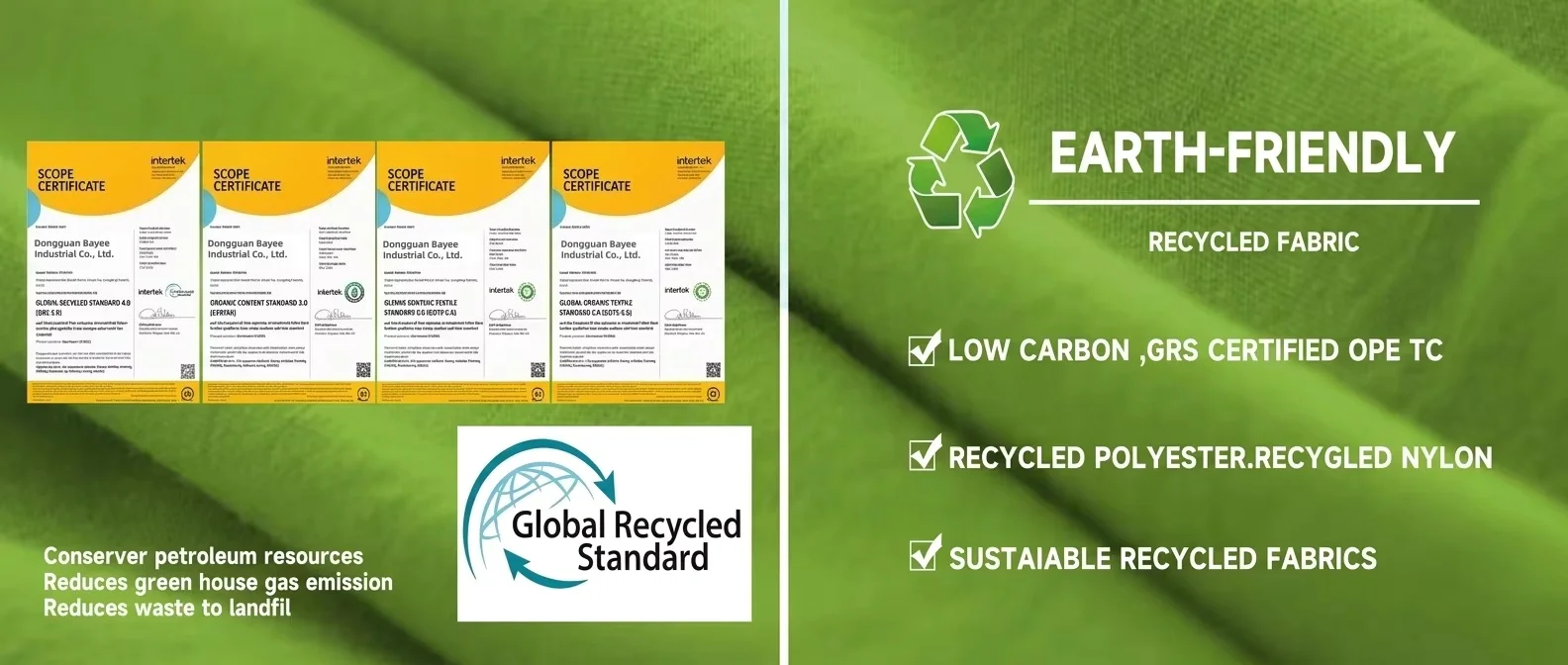
1. Quick overview: The 3 core European textile standards
| Compliance Standard | Regulatory Status | Governing Scope | What It Actually Tests / Verifies |
| EU REACH Regulation (EC 1907/2006) | Mandatory by Law across all 27 EU Member States | Chemical safety and consumer health protection | Prohibits SVHCs (Substances of Very High Concern): Azo dyes, nickel in metal zippers, phthalates in plastisol print, lead, PFAS |
| OEKO-TEX Standard 100 | Voluntary Private Certification (Widely demanded by EU retailers) | Product-level harmful substance safety | Tests finished fabrics, threads, prints, and trims against 1,000+ toxic chemicals; certifies safe for direct skin contact |
| GRS (Global Recycled Standard) | Voluntary International Standard (Mandatory for eco-labelling) | Chain-of-custody for recycled materials + social/chemical audits | Traces recycled raw material content (minimum 20% recycled content) with mandatory Transaction Certificates (TC) |
2. EU REACH compliance: The mandatory legal baseline
The REACH Regulation (Registration, Evaluation, Authorisation and Restriction of Chemicals) applies to every textile product sold in the EU, regardless of production origin. The European Chemicals Agency (ECHA) updates the restricted substances list (Annex XVII) continuously.
The 4 high-risk chemical zones in custom menswear Azo Dyes and Carcinogenic Amines:
1. Prohibited in dyed fabrics. Azo colorants can release harmful aromatic amines during sweat contact. Bayeeclothing uses exclusively certified eco-friendly reactive and disperse dyes.
Phthalates in Screen Prints and Puff Inks:
2. Toxic plasticizers used in low-grade plastisol ink are strictly capped at <0.1% by weight. Bayeeclothing uses 100% phthalate-free and PVC-free eco plastisol and water-based inks
Nickel Release from Metal Zippers and Snaps:
3. Metal hardware in contact with skin must not release nickel exceeding 0.5 µg/cm²/week to prevent allergic contact dermatitis. We fit compliant antique brass, gunmetal, or coated nylon zippers.
PFAS (“Forever Chemicals”) in Water-Repellent Outerwear:
4. EU member states increasingly restrict per- and polyfluoroalkyl substances in outerwear. Bayeeclothing uses C0 (fluorine-free) durable water repellent (DWR) finishes.
3. OEKO-TEX Standard 100: The commercial trust badge
While REACH is a legal requirement, OEKO-TEX Standard 100 is the consumer-facing certification that European department stores, boutiques, and multi-brand platforms demand before onboarding new apparel collections.
Class II Certification (Direct Contact with Skin):
- ● The relevant standard for menswear hoodies, t-shirts, sweatpants, and polo shirts.
Component-Level Verification:
- ● OEKO-TEX tests every single element of the finished garment—not just the outer cotton jersey, but also the sewing threads, printed graphic inks, woven neck labels, and drawstring cords.
Retailer Acceptance:
- ● Having OEKO-TEX certified fabrics dramatically speeds up retailer vendor onboarding across major European retail channels.
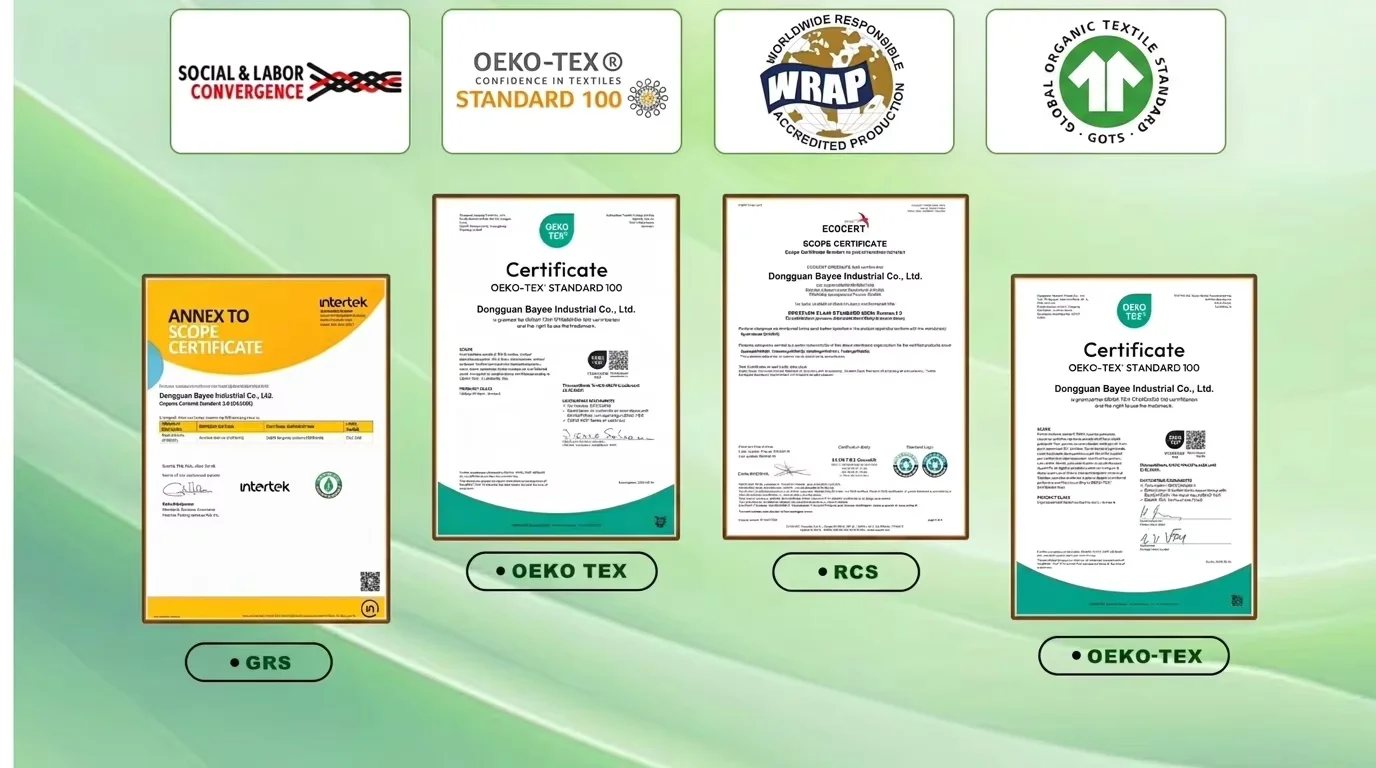
4. GRS (Global Recycled Standard): Backing up eco-streetwear claims
- European consumers and regulators actively penalize “greenwashing.” Under the EU Green Claims Directive, brands claiming “100% Recycled Cotton” or “Eco-Friendly Poly Tracksuit” must provide verifiable chain-of-custody documentation.[ GRS Supply Chain Traceability ]
Recycled PET Bottles / Cotton Clips ──> GRS Certified Mill ──> Bayeeclothing (Dongguan) ──> EU Importer
│
[ Transaction Certificate (TC) Issued ]The Transaction Certificate (TC) Requirement
- ● An official GRS certificate issued to a yarn mill is not sufficient on its own.
- ● For each commercial shipment, the manufacturer must provide a
Transaction Certificate (TC)
issued by an accredited certifier (e.g., Control Union, Intertek).
- ● The TC traces the specific batch of recycled fibre from raw input through finished cut-and-sew production to your commercial invoice.
5. EU mandatory garment labelling regulations
Under EU Textile Labelling Regulation (EU) No 1007/2011, imported menswear must feature compliant physical care labels:
Fiber Composition in Official National Languages:
1. Fiber names must match official EU nomenclature (e.g.,Cotton / Coton / Baumwolle) and list exact percentages in descending order (e.g.,100% Cotton or 80% Cotton / 20% Polyester). Identification of Importer / Manufacturer:
2. The label or packaging must display the EU importer’s registered business name and contact address.Standardized Ginetex Care Symbols:
3. Wash, bleach, dry, iron, and professional clean icons must follow ISO 3758 / Ginetex international standards.Country of Origin (“Made in China”):
4. Mandatory for customs clearance and retail sale across European member countries.
6. Manufacturing compliance capabilities at Bayeeclothing
Bayeeclothing assists European brands in maintaining complete regulatory compliance:
REACH & OEKO-TEX Aligned Supply Chain:
- ● Standard dye houses, chemical finishers, and printing ink suppliers verified for zero-SVHC compliance.
GRS Certified Recycled Programs:
- ● Direct sourcing of certified recycled cotton jersey and recycled polyester fleece, with official Transaction Certificates (TCs) provided for bulk orders.
Low-MOQ Execution:
- ● Compliant manufacturing starting from 30 pieces per style, enabling boutique brands to launch European-compliant collections without massive capital outlays.
Quality & Dimensional Control:
- ● 3,000 m² Dongguan facility with 7 production lines, 3 QC inspection lines =, and 7 senior pattern designers delivering precision S–5XL fits (monthly capacity 60,000+ pieces).
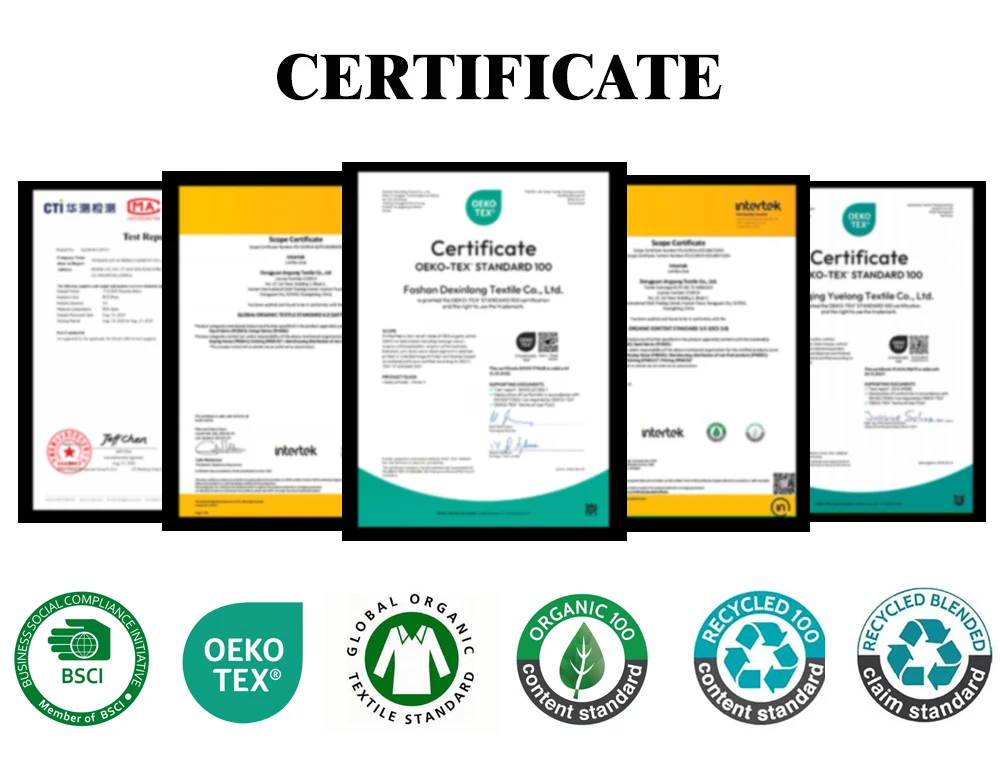
FAQ: EU apparel certification questions buyers ask most
1. Is REACH certification mandatory for selling menswear in the European Union?
Yes. REACH compliance is legally mandatory for all apparel sold in the EU. Garments must not contain restricted substances of very high concern (SVHCs) exceeding legal limits.
2. What is the difference between REACH and OEKO-TEX Standard 100?
REACH is a compulsory EU law prohibiting dangerous chemicals. OEKO-TEX is a voluntary international testing certification that verifies all garment components (fabrics, threads, zippers, inks) are safe from harmful substances.
3. How do I prove my hoodies use genuine recycled fabric in the EU?
To verify recycled claims legally, you must request an official GRS Transaction Certificate (TC) from your manufacturer for the specific production lot, tracing the recycled content from the mill to your invoice.
4. Can Bayeeclothing supply GRS-certified recycled cotton and polyester?
Yes. Bayeeclothing offers GRS-certified recycled cotton single jersey, recycled polyester fleece, and recycled blend textiles for custom streetwear programs.
5. What are the label language requirements for selling clothing in the EU?
Fiber composition labels must be translated into the official national language of each EU country where the garment is retailed (e.g., German for Germany, French for France, Italian for Italy).
6. Are phthalate-free inks required for screen prints entering Europe?
Yes. EU REACH Annex XVII restricts phthalate plasticizers in textile prints to less than 0.1%. Bayeeclothing uses 100% phthalate-free eco-plastisol and water-based inks.
7. Does custom menswear require CE marking in the EU?
No. Standard fashion apparel (t-shirts, hoodies, casual jackets) does not require CE marking. CE marking is only required for Personal Protective Equipment (PPE), such as motorcycle protective jackets or high-visibility workwear.
8. What is the minimum order quantity for EU-compliant custom clothing at Bayeeclothing?
Our minimum order quantity starts from 30 pieces per style, including full custom sizing (S–5XL), custom labelling, and REACH-compliant material execution.
9. How long does sample development take for EU-compliant streetwear?
Sample turnaround takes 3 to 5 working days using in-stock certified fabrics. Sample fees are transparently quoted and fully creditable against bulk orders.
10. Does Bayeeclothing provide third-party test reports (SGS / Intertek)?
Yes. Upon request, we can arrange third-party lab testing via SGS, Intertek, or TÜV Rheinland to verify colour fastness, fiber content, and REACH chemical parameters for your bulk shipment.
Buyer checklist: 7 compliance steps before importing apparel into the EU
1. Verify fabric supplier has valid OEKO-TEX or REACH compliance declarations.
2. Confirm printing inks are certified 100% phthalate-free and PVC-free.
3. Ensure metal hardware (zippers, snaps, eyelets) is certified nickel-free.
4. Request GRS Transaction Certificates (TC) if marketing garments as recycled.
5. Translate fiber composition labels into target destination languages.
6. Verify Ginetex care wash symbols and ISO 3758 icons are formatted correctly.
7. Confirm importer EU business name and address are included on packaging or wash tags.
Ready to launch your European-compliant menswear collection? Contact Bayeeclothing for certified fabric swatches, compliance documentation, and 3–5 day sample development.
Post time: Sep-29-2026


