A practical sourcing guide for fashion brands to verify direct apparel manufacturers, inspect business licenses, and eliminate middleman markups
For overseas apparel brands and streetwear founders sourcing custom garments in China, one fundamental question determines production pricing, technical control, and delivery timelines: is your supplier a direct manufacturing factory (OEM/ODM) or a third-party trading company (middleman)?
Trading companies aggregate products from external workshops, adding a 15% to 35% commission markup to unit costs while introducing communication delays during pattern adjustments and quality revisions. Conversely, partnering directly with an established cut-and-sew factory gives brand owners direct access to in-house master pattern designers, real-time workshop video inspections, transparent material costs, and agile prototype adjustments.
However, distinguishing between direct factories and well-packaged sourcing agencies is increasingly difficult on international B2B directories. Sourcing directors ask: what concrete verification steps, legal document audits, and technical checks expose whether a clothing supplier actually operates the cutting tables and sewing lines?
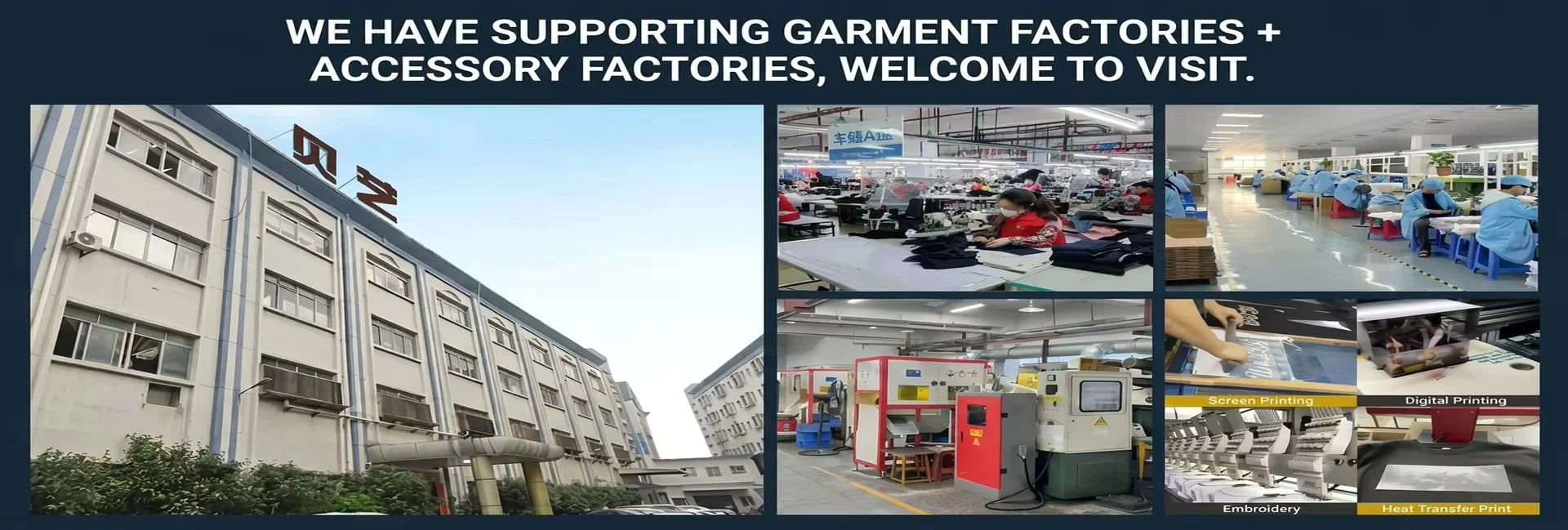
Bayeeclothing operates a self-owned 3,000 m² apparel manufacturing plant in Dongguan, China, equipped with 7 production lines, 3 dedicated QC lines, and an in-house team of 7 senior pattern designers (20+ years of experience) delivering custom streetwear from 30 pieces per design. This guide shares 7 proven verification methods buyers can execute before signing supply contracts.
1. Quick comparison: Direct factory vs trading company
| Evaluation Factor | Direct Manufacturer (e.g. Bayeeclothing) | Third-Party Trading Company |
| Pricing Structure | Direct factory ex-works pricing; zero middleman commission markups | 15% – 35% agency margin layered over factory costs |
| Pattern & Technical Control | In-house CAD master pattern designers; 24-hr revision turnaround | Relies on third-party sub-contractors; 3–5 day delay for pattern adjustments |
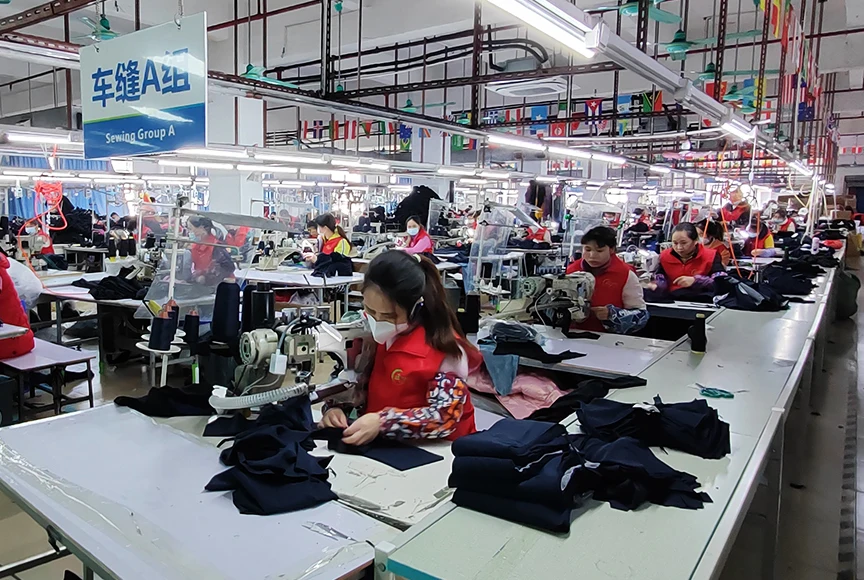
| Workshop Visibility | Live unscripted video walk-throughs of cutting, sewing, and QC lines | Relies on staged showroom photos; hesitates to show real-time production lines |
| Chinese Business License | Registered scope includes “Manufacturing / Production of Garments” | Registered scope limited to “Wholesale / Import & Export” |
| Sample Turnaround Speed | 3 – 5 working days using in-house sample rooms | 10 – 20 days due to external workshop queuing |
| Bulk Quality Consistency | 3 in-house QC inspection lines auditing raw fabric through final packing | Relies on external third-party QC or assumes workshop handles quality |
| Custom Flexibility | Low 30-piece MOQ with full custom sizing (S–5XL) and custom labelling | High MOQs (300–500 pcs) to satisfy external factory batch thresholds |
2. The 7 verification checks to prove factory legitimacy
[ Factory Verification Checklist ]
├── 1. Audit Chinese Business License Scope (Production vs. Trade)
├── 2. Request an Unscripted Live Video Tour
├── 3. Evaluate Technical Pattern Response Speed
├── 4. Inspect In-House Machinery & Fabric Libraries
├── 5. Verify ISO9001, BSCI, or GRS Audit Certificates
├── 6. Test Small-Batch Sampling Agility (3–5 Days)
└── 7. Compare Factory Address with Export Shipping Origin
Check 1: Audit the Registered Chinese Business License (Ying Ye Zhi Zhao)
Every legitimate Chinese business holds a government-issued Unified Social Credit Code license.
Direct Factory:
- ● Look under the “Business Scope” (Jing Ying Fan Wei). It must contain words like “Production” ,“Processing” , or“Manufacturing” of apparel.Trading Company:
- ● The scope will only state“Sales”,“Wholesale” , or “Import and Export of Goods”
Check 2: Request an Unscripted Live WhatsApp / WeChat Video Call
Ask the sales manager for a live video call during Chinese working hours (9:00 AM – 6:00 PM GMT+8). Ask them to walk from their office floor directly into the cutting room, sewing lines, and QC finishing stations.
- ● A direct factory can walk onto the floor immediately.
- ● A trading company will make excuses, claiming “the workshop is in another city” or “visitors are prohibited today.”
Check 3: Ask a Highly Technical Pattern Modification Question
Send a complex tailoring inquiry (e.g., “If we increase our fleece hoodie from 380 GSM to 500 GSM, by how many centimeters should we adjust the armhole depth and hood neck seam to prevent collar choking?”).
- ● A factory with in-house master pattern designers will provide a precise technical answer within hours.
- ● A trading agent must email the question to their supplier workshop and wait days for a response.
Check 4: Check Geographic Manufacturing Clusters
China’s apparel manufacturing is geographically concentrated in specialized industrial clusters:
Dongguan & Guangzhou (Guangdong Province):
- ● The global capital for streetwear, custom heavyweight hoodies, graphic T-shirts, and fashion sportswear.
- ● Suppliers located in high-rise financial centers in non-manufacturing cities without dedicated workshops are almost always trading agencies.
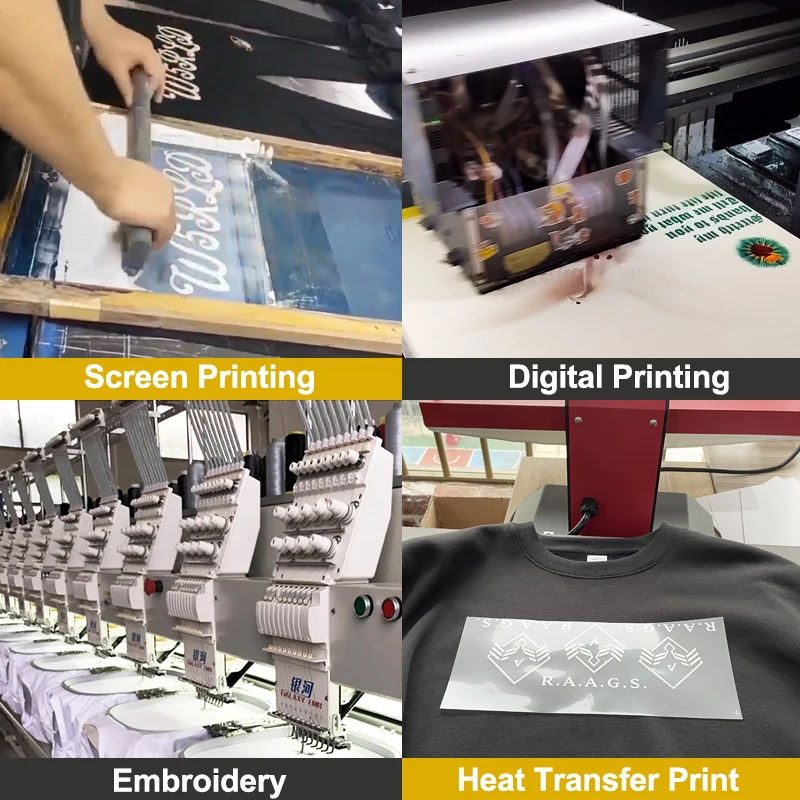
Check 5: Verify Environmental and Social Compliance Certificates (GRS / OEKO-TEX / BSCI)
Ask for the company’s GRS (Global Recycled Standard) or OEKO-TEX certificates. Check that the company name on the audit certificate exactly matches the legal business entity you are paying. Trading companies often present certificates belonging to unrelated sub-contractor mills.
Check 6: Order a 3–5 Day Proto-Sample
A factory with an integrated sample room can construct a custom hoodie prototype in 3 to 5 working days. Trading companies require 12 to 20 days because sample orders are passed down to independent workshops that prioritize large production runs.
Check 7: Verify Export Customs Registration and Shipping Origins
Inspect the commercial invoice and bill of lading (B/L). A direct manufacturer will export directly from their local regional port (e.g., Shenzhen / Guangzhou / Hong Kong for Dongguan factories)
3. When does working with a trading company make sense?
While direct factories provide superior pricing and customization for fashion apparel, trading companies can occasionally serve specific procurement needs:
Broad Multi-Category Merchandising:
- ● If a brand requires 50 completely unrelated promotional products simultaneously (e.g., plastic pens, umbrellas, metal keychains, and ceramic mugs), a trading agent can consolidate items from dozens of disparate factories.
Dedicated Custom Menswear:
- ● When building a dedicated clothing line (hoodies, T-shirts, tracksuits, outerwear),working directly with an OEM/ODM apparel manufacturer like Bayeeclothing is critical to control fabric GSM, shrinkage, print longevity, and margin viability.
4. Manufacturing infrastructure at Bayeeclothing
Bayeeclothing welcomes global brand founders and procurement teams to inspect our manufacturing facilities:
Self-Owned Industrial Plant:
- ● 3,000 m² specialized cut-and-sew manufacturing plant in Dongguan, Guangdong Province.
Integrated Production Capacity:
7 automated production lines and 3 dedicated QC lines
- ● with a monthly output exceeding 60,000+ pieces. In-House Master Pattern Team: 7 senior pattern engineers (20+ years of bespoke tailoring and CAD grading experience)
- ● ensuring precise S–5XL streetwear silhouettes.
Low-MOQ Direct Factory Access:
- ● Custom manufacturing starting from 30 pieces per style, with fit prototypes delivered in 3 to 5 working days
FAQ: Factory vs trading company sourcing questions
1. How can I confirm if an apparel supplier is a real factory before sending money?
Request their Chinese business license (Ying Ye Zhi Zhao) to verify that the business scope includes ‘manufacturing/production’ , and schedule an unscripted live video tour of the cutting and sewing workshop.
2. Why is buying directly from a factory cheaper than a trading company?
Direct factories eliminate third-party commission markups (typically 15% to 35%), offering transparent raw material and cut-make-trim (CMT) labor costs directly.
3. Does Bayeeclothing own its manufacturing facility?
Yes. Bayeeclothing operates a self-owned 3,000 m² apparel production facility in Dongguan, China, complete with cutting tables, 7 production lines, 3 QC inspection lines, and a dedicated sample room.
4. Can I visit Bayeeclothing in person or schedule a live video factory tour?
Yes. We encourage overseas brand founders to visit our Dongguan factory in person or schedule an unscripted live video walk-through via WhatsApp or WeChat to inspect our production lines and sample library.
5. What is the minimum order quantity (MOQ) at direct clothing factories?
While traditional bulk factories require 500+ pieces, Bayeeclothing supports agile fashion brands with a low direct-factory minimum order quantity of 30 pieces per style.
6. Do trading companies take longer to produce samples?
Yes. Trading companies typically take 12 to 20 days for samples because they sub-contract prototyping to external workshops, whereas Bayeeclothing’s in-house sample room delivers prototypes in 3 to 5 working days.
7. How do I verify if a factory’s certifications (GRS, OEKO-TEX) are genuine?
Check that the registered company name on the GRS certificate or OEKO-TEX scope declaration exactly matches the legal business name and bank account details of your supplier.
8. Can direct factories provide custom private labelling and custom packaging?
Yes. Bayeeclothing provides full OEM/ODM private label services, including custom woven neck tags, satin care labels, hangtags, metal zipper pulls, and branded frosted polybags.
9. What sizes can direct clothing manufacturers produce?
Bayeeclothing manufactures custom sizes from S to 5XL as standard, with custom digital CAD grading tailored to US, European, or Asian fit standards.
10. How does quality control differ between factories and trading companies?
Bayeeclothing maintains 3 in-house QC inspection lines (fabric inspection, in-line assembly audit, and final pre-pack measurement audit) to enforce AQL 2.5 standards before shipment.
Buyer checklist: 7 questions to ask on your first supplier call
1. “Can we do a quick live video walk-through of your sewing floor right now?”
2. “Is your business registered as a manufacturing enterprise or a trading company?”
3. “Do you have in-house master pattern designers to draft our CAD tech packs?”
4. “Where is your physical cut-and-sew facility located?”
5. “Can you produce custom prototypes within 3 to 5 working days?”
6. “What is your direct factory minimum order quantity per style?”
7. “Will sample development fees be credited against our bulk production invoice?”
Looking for a verified direct menswear manufacturer in China? Contact Bayeeclothing to schedule a live video tour, review our in-stock fabric library, and launch your 3–5 day sample prototype.
Post time: Oct-07-2026


