A technical comparison of loopback terry, brushed fleece, seasonal breathability, printing surface, and garment silhouettes
When streetwear brands develop hoodies, crewnecks, sweatpants, and lounge shorts, the two dominant fabric choices on every manufacturing spec sheet are French Terry and Brushed Fleece.
While both fabrics are typically knit from the same base yarns—most commonly 100% Combed Cotton or 80/20 CVC Poly-Cotton—their interior mechanical finishing gives them radically different thermal properties, drape silhouettes, and seasonal wearing profiles.
A common dilemma for apparel founders is determining which fabric aligns best with their climate release schedule, garment weight requirements, and target retail pricing. Choosing French Terry yields a breathable, moisture-wicking 3-season staple with a structured drape. Choosing Brushed Fleece creates an ultra-soft, heat-insulating winter garment with maximum interior loft.
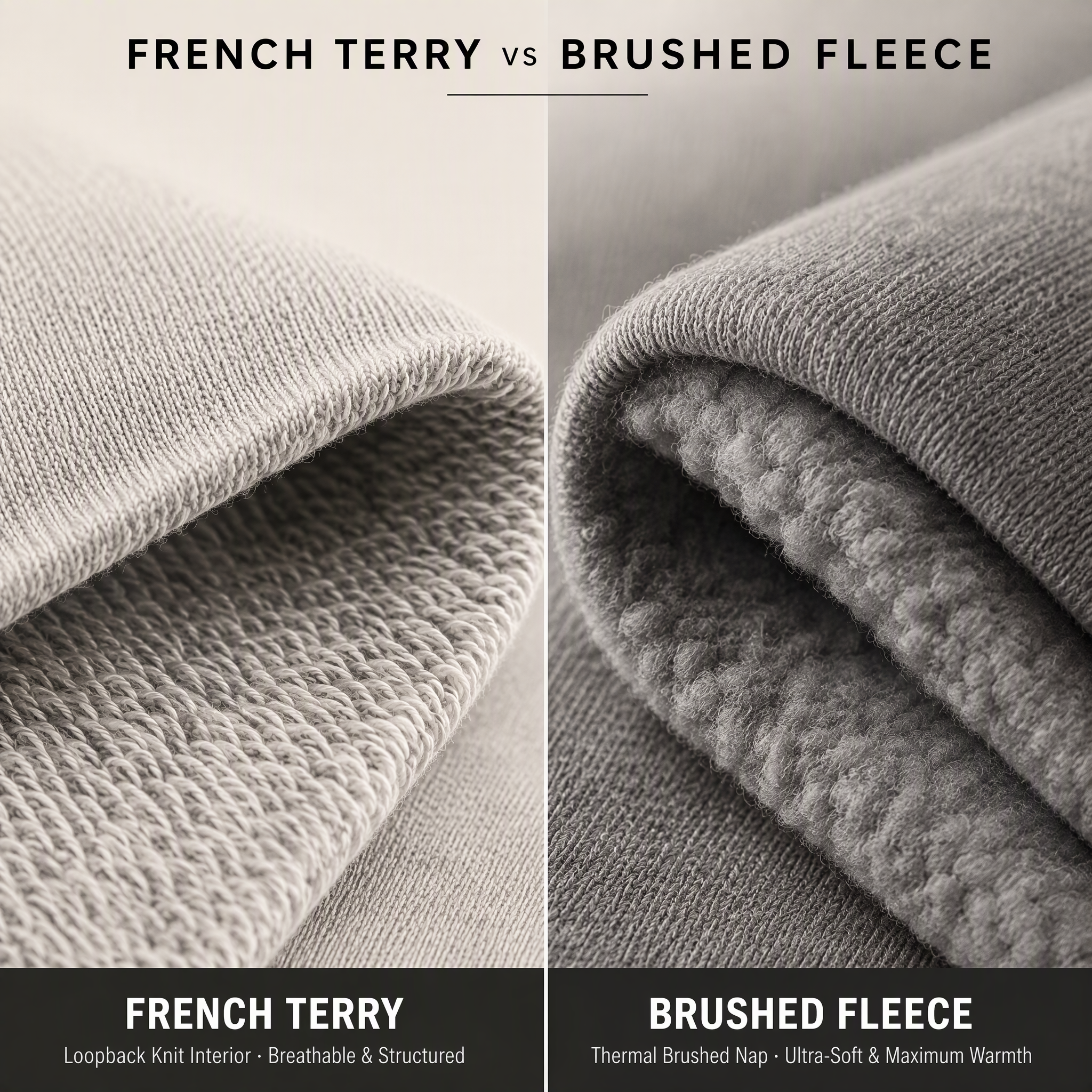
Bayeeclothing manufactures custom French terry and brushed fleece collections across 280 to 500+ GSM, supporting brand programs from 30 pieces per style with 3–5 day sample turnaround. This technical guide explains the structural, aesthetic, and production differences between French terry and brushed fleece.
1. Structural difference: Loopback vs napped interior
To understand why these fabrics perform differently, look at how they are finished on the knit loom:
French Terry (Loopback) ] [ Brushed Fleece (Napped) ]
┌──────────────────────────────┐ ┌──────────────────────────────┐
│ Smooth Flat Face (Jersey) │ │ Smooth Flat Face (Jersey) │
├──────────────────────────────┤ ├──────────────────────────────┤
│ Under-Loops (Unbrushed) │ ======> │ Mechanical Wire Brushing │
│ - Absorbs moisture │ (Brushing) │ - Loops raised into fuzz │
│ - Circulates airflow │ │ - Traps air for insulation │
└──────────────────────────────┘ └──────────────────────────────┘
French Terry (Loopback):
1. Knit as a 3-end circular knit fabric. The face side is smooth and flat jersey, while the reverse side features microscopic unbrushed yarn loops. These loops lift the fabric slightly off the skin, promoting airflow and absorbing perspiration.
Brushed Fleece (Napped):
2. Starts as the exact same loopback knit. The fabric is then fed through a rotary napping machine equipped with fine wire brushes. These mechanical wire rollers tear open the surface yarn loops, teasing them into a soft, fuzzy, fibrous nap.
2. Head-to-head performance comparison
| Feature | French Terry (Loopback) | Brushed Fleece (Napped) |
| Interior Texture | Flat, textured yarn loops (clean & dry) | Fuzzy, plush, cloud-like downy nap |
| Seasonal Wearability | 3-Season (Spring, Summer nights, Autumn) | Cold Weather (Late Autumn, Winter) |
| Breathability & Airflow | High; loops allow cross-ventilation | Low to Moderate; napped fibres block airflow |
| Thermal Insulation | Moderate thermal barrier | High thermal barrier; traps body heat in dead air |
| Garment Drape & Silhouette | Clean, structured, architectural fall | Voluminous, rounded, soft streetwear drape |
| Interior Fibre Shedding | Zero shedding; loops remain intact | May shed minor loose fuzz on first 1–2 washes |
| Surface Smoothness for Printing | Exceptionally smooth and stable | Smooth outer face; interior holds lofty cushion |
| Best Used Menswear Items | Transitional hoodies, sweat shorts, zip-ups | Heavyweight winter hoodies, joggers, balaclavas |
3. When to choose French Terry for your menswear collection
Application 1: Spring, Summer, and Transitional Drops
If your release calendar targets Spring/Summer or early Autumn drops, French terry is the superior technical choice. The interior loopback structure wicks skin moisture and breathes naturally, preventing sweat buildup in moderate temperatures (15°C to 25°C / 60°F to 77°F).
Application 2: Sweat Shorts and Lightweight Sets
French terry is the industry standard for custom lounge shorts and matching summer short-sets. Brushed fleece is too warm for leg wear in warm weather and can cling uncomfortably to damp skin.
Application 3: Crisp, Tailored Streetwear Silhouettes
Because loopback terry is unbrushed, it maintains a denser, flatter profile for a given GSM weight. A 400 GSM French terry hoodie drapes with crisp, sharp lines that emphasize oversized shoulder drops without looking overly puffy or bulky.
4. When to choose Brushed Fleece for your collection
Application 4: Autumn and Winter Heavyweight Drops
For sub-zero climates and late-season winter releases, brushed fleece delivers unbeatable insulation. The brushed fibres trap pockets of stagnant warm air between the skin and the fabric outer shell, providing superior warmth without requiring heavy down lining.
Application 5: Cozy, Cocoon-Like Interior Comfort
Consumers buying oversized winter loungewear prioritize tactile plushness against bare skin. The brushed interior provides instant, soft tactile warmth the moment the wearer puts it on.
Application 6: Rounded, Voluminous Streetwear Hoodies
When designers seek the puffy, rounded silhouette popularized by modern luxury streetwear, 450–500 GSM brushed fleece provides the necessary structural expansion to hold generous sleeve stacks and balloon silhouettes.
5. Printing and decoration performance comparison
Both fabrics share a smooth jersey face, but their interior differences affect decoration engineering:
Screen Printing & DTG:
- ● Both fabrics take water-based and plastisol inks cleanly on the smooth face.
High-Density Puff Print:
- ● French terry provides a slightly firmer, less yielding base that holds crisp, straight geometric edges on high-rise puff graphics.
-
Heavy Chest Embroidery:
- ● Brushed fleece requires specialized tear-away or water-soluble stabilizer backing during machine embroidery to prevent dense needle clusters from sinking into the soft cushion.
Acid Wash & Vintage Stonewash:
- ● 100% cotton French terry absorbs enzyme stone washes evenly across both face and interior loops. On brushed fleece, heavy stone tumbling can create minor surface fuzzing, which must be managed with bio-polishing.
6. Manufacturing custom terry and fleece at Bayeeclothing
At Bayeeclothing, we engineer both fabric types to rigorous export standards:
Weight Range:
- ● In-stock and custom French terry and fleece available from280 GSM (lightweight/transitional) to 400 GSM (core streetwear) and 500+ GSM (ultra-heavy luxury).
Composition Choices:
- ● 100% Combed Cotton, 80/20 CVC Poly-Cotton (for maximum fleece loft), and GRS-certified recycled yarn options.
Low-MOQ Production:
- ● Start custom cut-and-sew production from 30 pieces per design, allowing you to sample and test both terry and fleece variants.
Rapid Prototyping:
- ● Complete sample development in 3–5 days, supported by our 7 senior pattern designers (20+ years of experience)
and our 3,000 m² Dongguan facility with 7 dedicated lines and 3 QC inspection lines (monthly capacity 60,000+ pieces).
FAQ: French Terry vs Fleece buyer questions
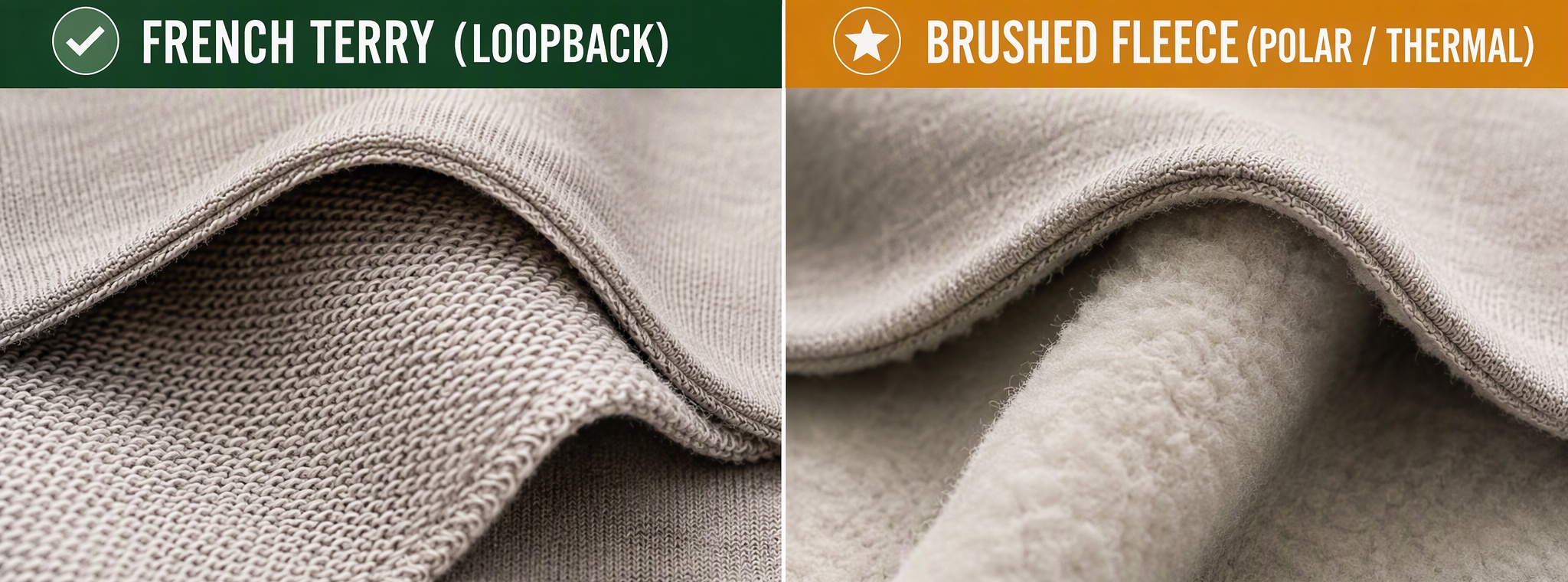
1. What is the fundamental difference between French Terry and Fleece?
French Terry has unbrushed, looped yarn on the inside, offering breathability and moisture-wicking properties. Fleece takes the same fabric and mechanically brushes the interior loops into a fuzzy, napped surface that traps body heat for winter insulation.
2. Is French Terry or Brushed Fleece better for custom streetwear hoodies?
It depends on the target season. French Terry (380–450 GSM) is ideal for 3-season wear with a crisp, structured drape. Brushed Fleece (400–500 GSM) is best for winter releases where maximum warmth, plush hand-feel, and rounded volume are desired.
3. Which fabric is better for custom sweat shorts?
French Terry is universally preferred for sweat shorts. The interior loops breathe and wick perspiration, while brushed fleece is too warm and traps excessive heat in warm weather.
4. Does brushed fleece pill more than loopback French terry?
Untreated brushed fleece is slightly more prone to surface friction pilling over time because loose fibres have already been mechanically disturbed. Bayeeclothing applies bio-polishing and anti-pilling finishes to stabilize the fleece surface.
5. Can both French terry and brushed fleece be made in 100% cotton?
Yes. Both fabrics can be knit from 100% combed cotton. However, for brushed fleece, many brands prefer an 80/20 CVC blend because the polyester core keeps the brushed interior plush and lofty through repeated domestic washings.
6. Which fabric is more breathable?
French Terry is significantly more breathable. The microscopic loop structure allows continuous airflow between the body and the garment, making it comfortable in indoor and outdoor transitional weather.
7. Does French terry shrink more than fleece?
Both fabrics have similar shrinkage rates (3–6% untreated for 100% cotton). Bayeeclothing pre-shrinks all knits to keep post-wash shrinkage under commercial tolerance standards (±3%).
8. Does Bayeeclothing manufacture custom French terry hoodies with a 30-piece MOQ?
Yes. Bayeeclothing manufactures custom French terry and fleece garments starting from 30 pieces per style, including custom sizing (S–5XL), custom dyeing, and custom branding.
9. How long does sample development take for fleece and terry at Bayeeclothing?
Proto-sampling takes 3–5 days once tech pack specifications, measurements, fabric weight (GSM), and artwork files are confirmed. Sample fees are quoted based on design complexity.
10. Can I do vintage acid wash on both French terry and fleece?
Yes. As long as the fabric is 100% cotton, both French terry and fleece can undergo acid wash, enzyme stonewashing, and vintage pigment dyeing.
Buyer checklist: Specifying French Terry vs Fleece in tech packs—Before submitting your tech pack for sampling, confirm these 8 technical criteria:
1. Interior finish selected (Unbrushed Loopback French Terry vs Brushed/Napped Fleece).
2. Fibre composition specified (100% Combed Cotton, 80/20 CVC, or GRS Recycled Cotton).
3. Target fabric weight defined (e.g., 380 GSM, 420 GSM, or 480 GSM ± 10g).
4. Ribbing specification confirmed (Matching Cotton/Spandex 2×2 Rib with 3–5% Spandex).
5. Pre-shrinkage and anti-pilling standard stated (Pre-shrunk tolerance under ±3%).
6. Anti-shedding wash treatment required for fleece (Enzyme bio-wash specified).
7. Decoration method matched to fabric surface (Puff print, screen print, or embroidery).
8. Size grading defined (Oversized boxy drop-shoulder fit from S to 5XL).
Ready to sample custom French terry or brushed fleece hoodies? Send your tech pack, target GSM, and artwork to Bayeeclothing for an exact quotation and 3–5 day sample turnaround.
Post time: Sep-29-2026


