The GSM Paradox: Why Fabric Weight Alone Does Not Guarantee Garment Quality
When fashion designers, procurement managers, and streetwear brands source blank garments or develop custom cut-and-sew collections, GSM (Grams per Square Meter) is the single most referenced specification.
However, apparel buyers frequently fall into two critical misconceptions:
“Heavier is Always Better” Myth
1. : Sourcing excessively heavy 300+ GSM single-jersey T-shirts made with coarse, low-twist open-end yarns results in stiff, non-breathable garments that feel rough against the skin and shrink unevenly.
“Lightweight Means Cheap” Myth
2. : Dismissing 160–180 GSM luxury Pima or Egyptian long-staple cotton T-shirts that offer silky handfeel, high tensile strength, and superior thermal breathability for summer climates.
True garment excellence lies in the synergy between GSM (weight), Yarn Count (yarn fineness such as 21s/2, 32s/2, 40s), Spinning Method (combed ring-spun vs. open-end), and Mechanical Pre-Shrinking (Sanforization).
To provide clear industry standards, Bayeeclothing has compiled this technical benchmark to help menswear buyers make data-backed fabric decisions.
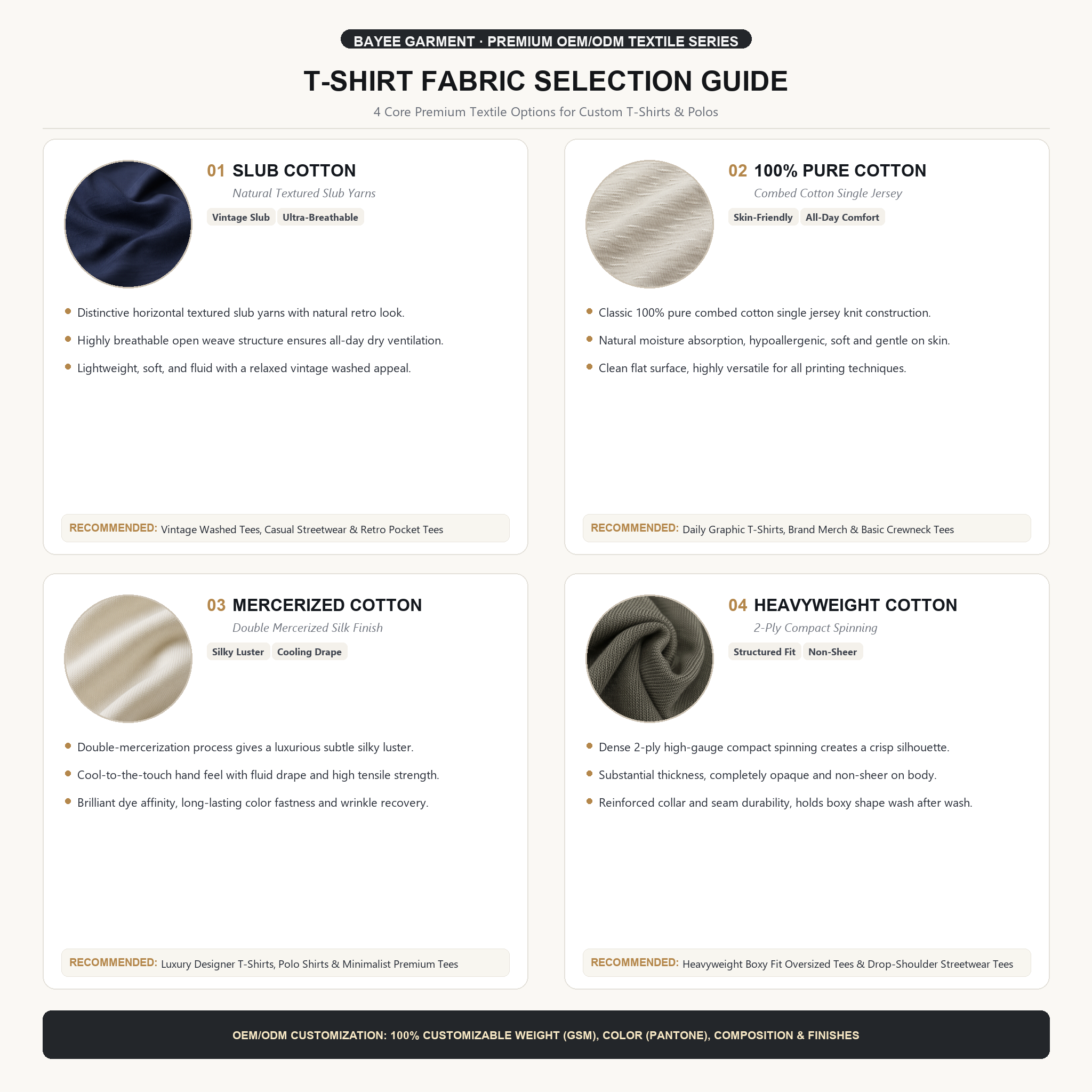
1. Technical Benchmark: T-Shirt Weight Categories (160 to 300+ GSM)
+—————————————————————————–+
| MEN’S T-SHIRT GSM FABRIC WEIGHT MATRIX |
+—————————————————————————–+
| Weight Category | GSM Range | Yarn Spec & Structure | Best Application & Drape Characteristics |
+—————–+—————+———————–+——————————————-+
| Lightweight | 150–180 GSM | 32s/1 or 40s/1 Combed | Summer activewear, undershirts, soft drape|
| Midweight | 190–230 GSM | 26s/1 or 32s/2 Combed | Daily retail standard, balanced opacity |
| Heavyweight | 240–280 GSM | 21s/2 Double-Ply Cotton| Structured boxy fit, zero nipple-show |
| Super Heavy | 300–350+ GSM | 16s/2 or 21s/2 Interlock| Architectural streetwear, autumn outerwear|
+—————————————————————————–+
[ 100% COMBED LONG-STAPLE COTTON YARN (32s/2 OR 21s/2 DOUBLE-PLY) ]
|
v
[ HIGH-DENSITY CIRCULAR KNITTING (CALIBRATED TENSION & DENSITY) ]
|
v
[ TENSION-FREE MECHANICAL SANFORIZATION (PRE-SHRUNK SHRINKAGE < 3%) ]
|
v
[ 1x1 / 2x2 HIGH-RECOVERY SPANDEX RIB COLLAR + SHOULDER-TO-SHOULDER TAPING ]
|
v
[ BIO-POLISHING ENZYME WASH (ZERO PILLING & SILKY SURFACE) ]
1.1 The Golden Standard for Streetwear T-Shirts: 240–280 GSM
For modern oversized and boxy silhouettes, 240–280 GSM 100% combed double-ply cotton is the global industry benchmark. At this weight:
Total Opacity
- ● : Completely eliminates transparency (no “nipple-show” in white colorways).
Structural Hold
- ● : The fabric possesses sufficient body to maintain a clean drop-shoulder drape without clinging to body fat.
Print Stability
- ● : Provides a smooth, stable ground for heavy plastisol screen printing, DTG photorealistic prints, and high-density 3D puff embroidery.
2. Technical Benchmark: Hoodie & Sweatshirt Weight Categories (300 to 500+ GSM)
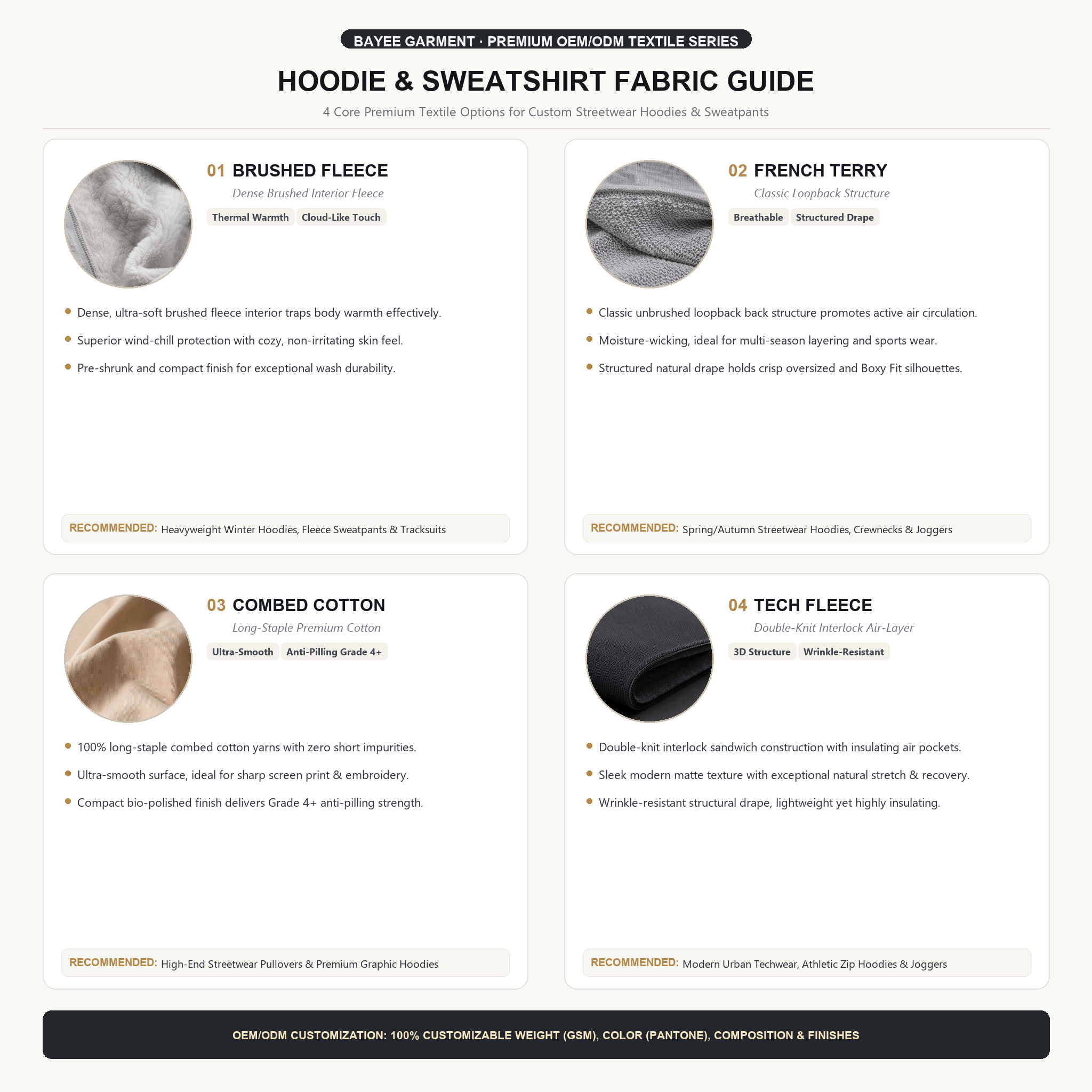
Hoodie weights are significantly heavier and are divided into two fundamental fabric constructions: French Terry and Brushed Fleece.
+—————————————————————————–+
| MEN’S HOODIE GSM FABRIC WEIGHT MATRIX |
+—————————————————————————–+
| Category | GSM Range | Fabric Construction | Performance & Thermal Properties |
+—————–+—————+———————–+——————————————-+
| Midweight Terry | 300–350 GSM | 100% Cotton Loopback | Spring/Autumn transition, breathable sweat|
| Heavy French Terry| 380–420 GSM | 100% Cotton 3-End Terry| Structured hood drape, four-season comfort|
| Heavyweight Fleece| 380–450 GSM | 80/20 Cotton/Poly Fleece| Brushed interior, high warmth-to-weight |
| Luxury Ultra-Heavy| 480–550+ GSM| 100% Combed Terry/Fleece| Deep winter insulation, heavyweight drape|
+—————————————————————————–+
2.1 French Terry vs. Brushed Fleece: Which Should You Choose?
3-End French Terry (380–420 GSM)
- ● : Uses three distinct yarns (face yarn, tie yarn, and back loop yarn). It offers superior breathability, moisture absorption, zero inner fiber shedding, and creates a crisp, structured hood that stands upright naturally.
Brushed Cotton-Poly Fleece (400–450 GSM)
- ● : The interior loops are napped with wire brushes to create a soft, insulating air-trapping cushion. Ideal for sub-zero autumn/winter streetwear collections.
3. Four Quality Pillars Beyond GSM: What Truly Defines a Luxury Garment
1. Long-Staple Combed Cotton vs. Open-End Carded Cotton
Low-cost factories use coarse open-end (OE) rotor yarns to reach a 250 GSM target cheaply. While thick, open-end cotton pills rapidly (ISO 12945-2 < Grade 2.5) and feels harsh. In contrast, combed ring-spun cotton removes short fibers, aligning long filaments to achieve silky softness, high burst strength, and pill resistance (Grade 4.0+).
2. Dimensional Stability & Pre-Shrunk Finishing
Unsanforized heavy cotton knits can shrink over 8%–10% after consumer washing. Bayeeclothing applies continuous tension-free mechanical sanforization and bio-enzyme wash treatments, locking post-wash dimensional shrinkage to under 3.0%.
3. Heavy-Duty Ribbing & Anti-Bacon Collar Engineering
To prevent the dreaded wavy “bacon collar”:
- ● Collars are constructed with 450 GSM 95% Cotton / 5% High-Recovery Spandex 1×1 or 2×2 ribbing.
- ● Interior necklines feature continuous herringbone shoulder-to-shoulder seam taping with twin-needle chainstitching.
4. High-Precision Weight Tolerance
Mass manufacturing often suffers from ±10% GSM variance between dye lots. Our automated circular knitting monitoring keeps batch weight tolerance strictly within ±3% GSM.
4. Bayeeclothing Custom Manufacturing Capability Matrix
+—————————————————————————–+
| BAYEECLOTHING KNITWEAR MANUFACTURING SPECIFICATIONS |
+—————————————————————————–+
| Minimum Order Quantity (MOQ) | Low-MOQ friendly (From 30 pcs/design) |
| T-Shirt Weight Range Options | 160 GSM to 350 GSM Custom Knitting |
| Hoodie Weight Range Options | 300 GSM to 550+ GSM Loopback / Fleece |
| Fabric Composition Choices | 100% Combed Cotton, GOTS Organic Cotton, |
| | 80/20 Cotton-Poly, Cotton/Modal Blends |
| Color Dyeing & Wash Effects | Reactive Piece Dye, Pigment Garment Dye, |
| | Vintage Acid Wash, Silicone Softener Dip |
| Embellishment Techniques | High-Density Screen, DTG, 3D Puff Embroidery|
| Size Inclusivity Matrix | Full inclusive sizing from S to 5XL |
| Proto-Sampling Turnaround | 3–5 working days (Full custom sample) |
| Bulk Production Turnaround | 15–20 working days |
| In-House Quality Assurance | 100% Needle detection, wash test & AQL 2.5 |
+—————————————————————————–+
Frequently Asked Questions (FAQ) — Sourcing Custom T-Shirts & Hoodies
1. What does GSM stand for in clothing manufacturing?
GSM stands for Grams per Square Meter (g/m²). It is the metric measurement of fabric density and weight, directly indicating fabric thickness, opacity, and substance.
2. What is the best GSM weight for a summer men’s T-shirt?
For hot summer weather, 200 to 220 GSM 100% combed cotton offers the ideal balance—providing complete opacity without transparency, while remaining lightweight and breathable.
3. What GSM is recommended for oversized streetwear hoodies?
For modern boxy streetwear hoodies with a structured hood that stands upright without collapsing, we recommend 380 to 450 GSM French Terry or Brushed Fleece.
4. Why do some heavyweight T-shirts feel rough and pill easily?
Those shirts are knitted with low-grade open-end (OE) carded yarn rather than combed ring-spun cotton. High weight without combed long-staple fibers results in scratchy textures and surface pilling.
5. How does Bayeeclothing prevent heavy cotton garments from shrinking after washing?
All our fabrics undergo continuous mechanical sanforization and bio-enzyme pre-washing, stabilizing yarn tension to guarantee residual shrinkage strictly under 3.0%.
6. Can heavy 300+ GSM T-shirts be customized with DTG and screen printing?
Yes. High-density combed cotton provides an ultra-smooth, low-fuzz surface that delivers exceptionally sharp lines and vibrant color saturation for both screen printing and Direct-to-Garment (DTG).
7. What is the minimum order quantity (MOQ) for custom GSM knitwear?
We support startup labels, streetwear brands, and corporate clients with flexible low MOQs starting from 30 pieces per style/colorway, with mixed sizing from S to 5XL.
8. What size range is available for custom cut-and-sew knitwear?
We provide complete size grading across S to 5XL, tailored for standard retail, athletic, and modern oversized streetwear fits.
9. What details should brands include in a knitwear Tech Pack?
A complete Tech Pack should include targeted fabric weight (e.g., 260 GSM), yarn composition, garment measurements (chest, length, shoulder drop), Pantone TCX codes, print artwork files (.AI/.PDF), and ribbing specifications.
10. What are the sampling and bulk production lead times?
Custom proto-samples (including custom dyeing, printing, or embroidery) are completed in 3 to 5 business days. Bulk production is delivered within 15 to 20 working days.
Post time: Nov-20-2026


