A technical streetwear guide comparing 3D puff expansion ink, flat plastisol, washing longevity, and fabric compatibility
In streetwear apparel graphics, Puff Printing (3D high-density foam expansion) has become one of the most requested decoration techniques for oversized hoodies, heavyweight T-shirts, and matching sweat sets. Its distinct tactile, raised surface gives brand typography and logos a bold, three-dimensional presence that flat 2D printing cannot replicate.
However, brand founders frequently encounter customer complaints when puff prints are executed poorly: surface cracking, crumbling, peeling, or collapsing after only 2 or 3 domestic washing machine cycles. This leads sourcing managers to ask: how does puff print durability compare to standard screen printing, and what factory controls prevent 3D puff graphics from cracking?
The technical truth is that high-quality puff printing is exceptionally durable—lasting 40+ wash cycles without cracking—provided the factory accurately controls mesh count, blowing agent ratio, curing conveyor temperature (160°C to 170°C), and fabric weight anchors. When applied to lightweight, stretchy fabrics or cured incorrectly, puff print will fail. When anchored to 240+ GSM jersey or 400+ GSM fleece, it remains a permanent, premium feature.
Bayeeclothing manufactures custom puff print, screen print, and 3D embroidered streetwear from 30 pieces per design, backed by in-house tunnel curing ovens, 7 production lines, and 3 dedicated QC lines (monthly capacity 60,000+ pieces). This guide breaks down the science of puff print durability.
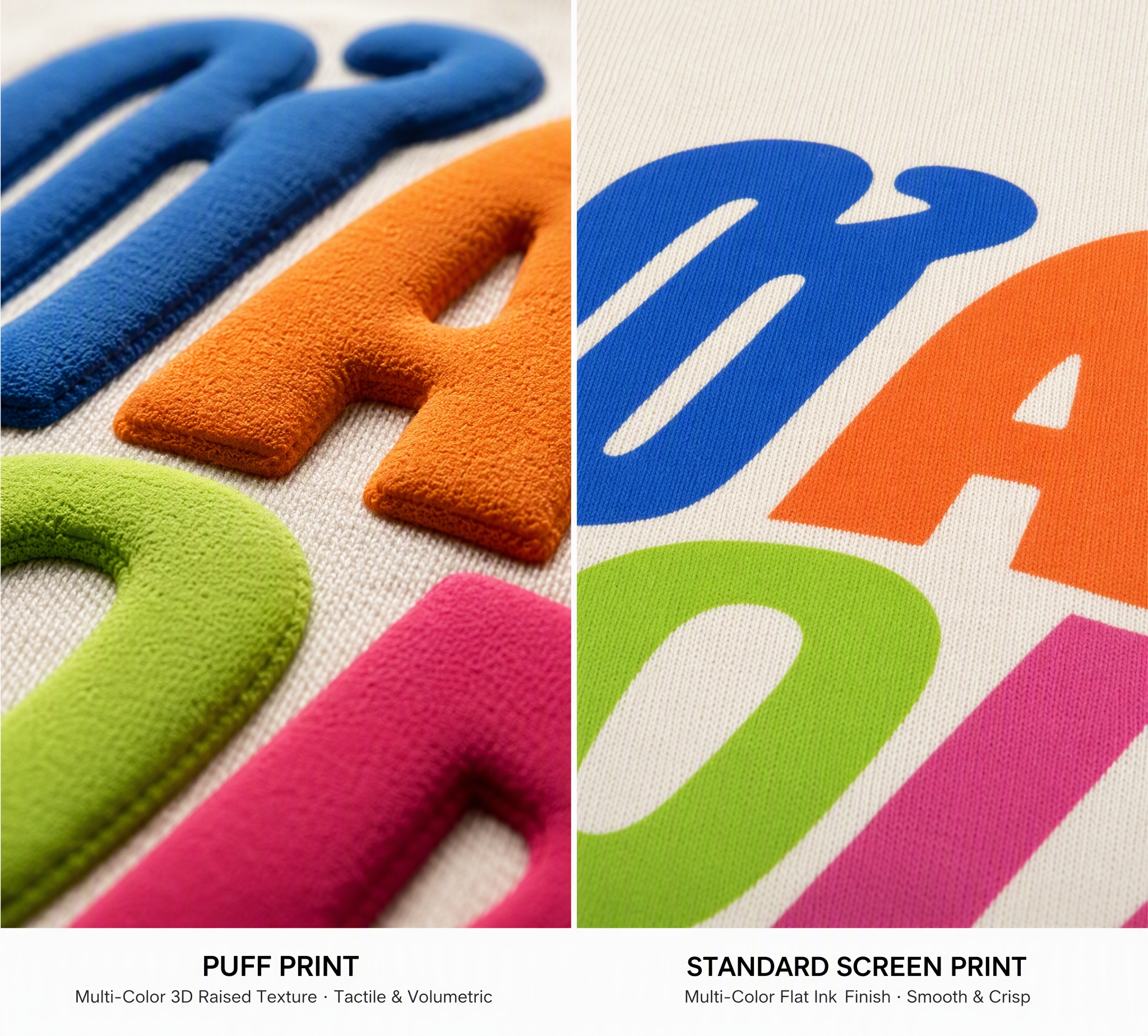
1. Technical comparison: Puff print vs standard screen print
| Feature | 3D Puff Print (Plastisol Foam) | Standard Screen Print (Plastisol / Water-Based) |
| Visual & Tactile Effect | Raised, 3D foam relief (1.5 mm to 3.0 mm height); marshmallow or matte leather hand | Flat 2D print; smooth matte or semi-gloss hand-feel |
| Ink Chemistry | Plastisol base blended with heat-reactive foaming/blowing agents | Standard plastisol resins or water-based pigment binders |
| Expansion Mechanism | Expands and rises vertically when heated in curing tunnel (160°C–170°C) | Cures flat without vertical expansion |
| Wash Durability | Highly durable when cured properly (40+ washes); sensitive to high-heat dryers | Maximum durability (50+ to 100+ washes); highly resistant to abrasion |
| Recommended Fabrics | Heavyweight 100% Combed Cotton (240+ GSM tees, 380–500 GSM hoodies) | All fabric weights (150–500 GSM), cotton, poly-cotton, polyester |
| Detail Resolution | Best for bold typography, thick line art, and block shapes | High-definition fine lines, halftone gradients, multi-colour photo art |
| Target Retail Positioning | Premium streetwear, luxury statement drops ($85–$140 hoodies) | Core graphic tees, commercial merch, everyday streetwear ($45–$95) |
2. Why cheap puff prints crack (and how Bayeeclothing fixes it)
A common myth is that “all puff print eventually cracks.” In reality, puff print failure is always caused by one of three manufacturing mistakes:
[ Problem 1: Under-Curing ] ──> Core ink stays soft, leading to peeling in wash.
[ Problem 2: Over-Expansion ] ──> Too much blowing agent creates thin cell walls that snap.
[ Problem 3: Light Fabric ] ──> Thin jersey stretches beneath rigid foam, cracking ink.
======> Bayeeclothing Standard:
✓ Heavyweight 240+ GSM Cotton Base ✓ Calibrated 165°C Tunnel Curing ✓ Anti-Crack Elastic Binders
Under-Curing in the Dryer Tunnel:
1. If the conveyor dryer runs too fast or below 160°C (320°F), the surface of the foam expands, but the core resin does not fully cross-link. During domestic laundering, water penetrates the uncured core, causing the print to flake off.
Excessive Blowing Agent Concentration:
2. Adding too much foaming additive creates dramatic height, but makes the internal air cell walls paper-thin and brittle. Bayeeclothing formulates a balanced 15–20% puff additive ratio to ensure high structural tensile strength.
Mismatched Fabric Stretch:
3. Printing thick puff ink onto thin, stretchy 150 GSM jersey causes the fabric to stretch underneath while the ink resists, cracking the graphic along stretch lines.
3. Best design practices for puff print graphics
To maximize both aesthetic impact and durability, follow these 4 artwork guidelines:
Keep Line Thickness Above 2 mm:
1. Puff expansion closes tight negative spaces. Thin lines under 1.5 mm will blur together or fail to rise cleanly.
Avoid Intricate Halftones and Gradients:
2. Puff ink expands uniformly in 3D; it cannot render photographic dot gradients. Use solid vector shapes and bold typography.
Combine Flat Screen Print with Puff Accents:
3. For multi-colour designs, use flat screen print for detailed secondary text and puff print for the main brand logo to create dynamic depth.
Anchor to 100% Heavyweight Cotton:
4. The stable, non-stretch weave of 240–300 GSM cotton jersey or 400–500 GSM cotton fleece provides the ideal non-yielding substrate for 3D puff graphics.
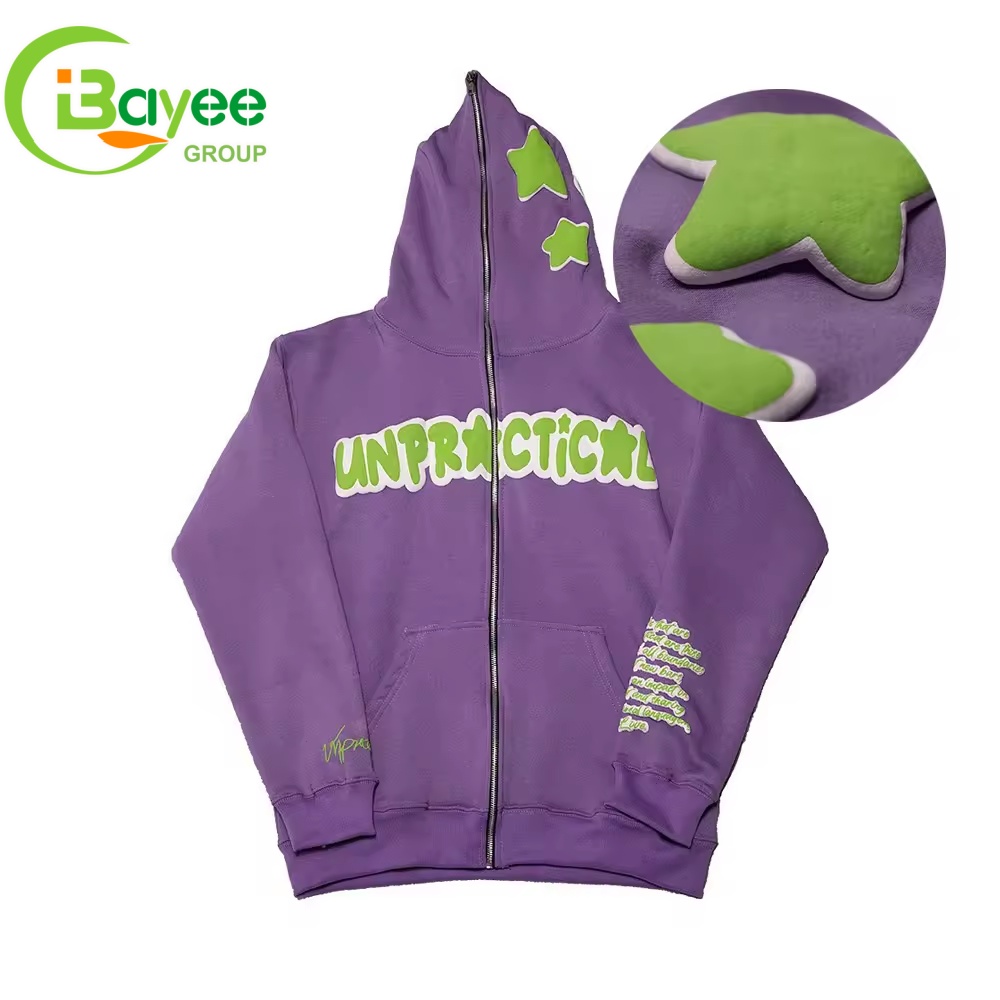
4. Wash care instructions to protect custom puff print garments
When delivering puff print apparel to retail consumers, always include these 4 wash care recommendations on your woven wash tags:
Wash Inside Out:
- ● Turn the garment inside out to protect the raised foam surface from abrasive contact with zippers and machine drums.
Cold Water Cycle:
- ● Wash in cold water (max 30°C / 85°F) on a gentle cycle.
Air Dry / Line Dry:
- ● Avoid high-heat commercial tumble dryers. High heat can soften cured plastisol foam and degrade cell structure.
Never Iron Directly Over the Print:
- ● Direct contact with a hot iron will melt and flatten the 3D puff structure permanently.
5. Custom puff printing capabilities at Bayeeclothing
Bayeeclothing operates automated screen printing and tunnel curing lines tailored for streetwear graphics:
Precision Foam Formulations:
- ● Custom-mixed matte, satin, and high-density puff inks that retain vertical height and elasticity.
Low-MOQ Production:
- ● Custom puff print manufacturing starting from 30 pieces per design, allowing emerging brands to test high-impact 3D graphics without high setup thresholds.
Rapid 3–5 Day Sampling:
- ● Dedicated sample room producing exact puff prototypes in 3 to 5 working days, verified for expansion height and cure density.
Full Factory Integration:
- ● 3,000 m² facility in Dongguan with 7 production lines and 3 QC inspection lines (monthly capacity 60,000+ pieces).
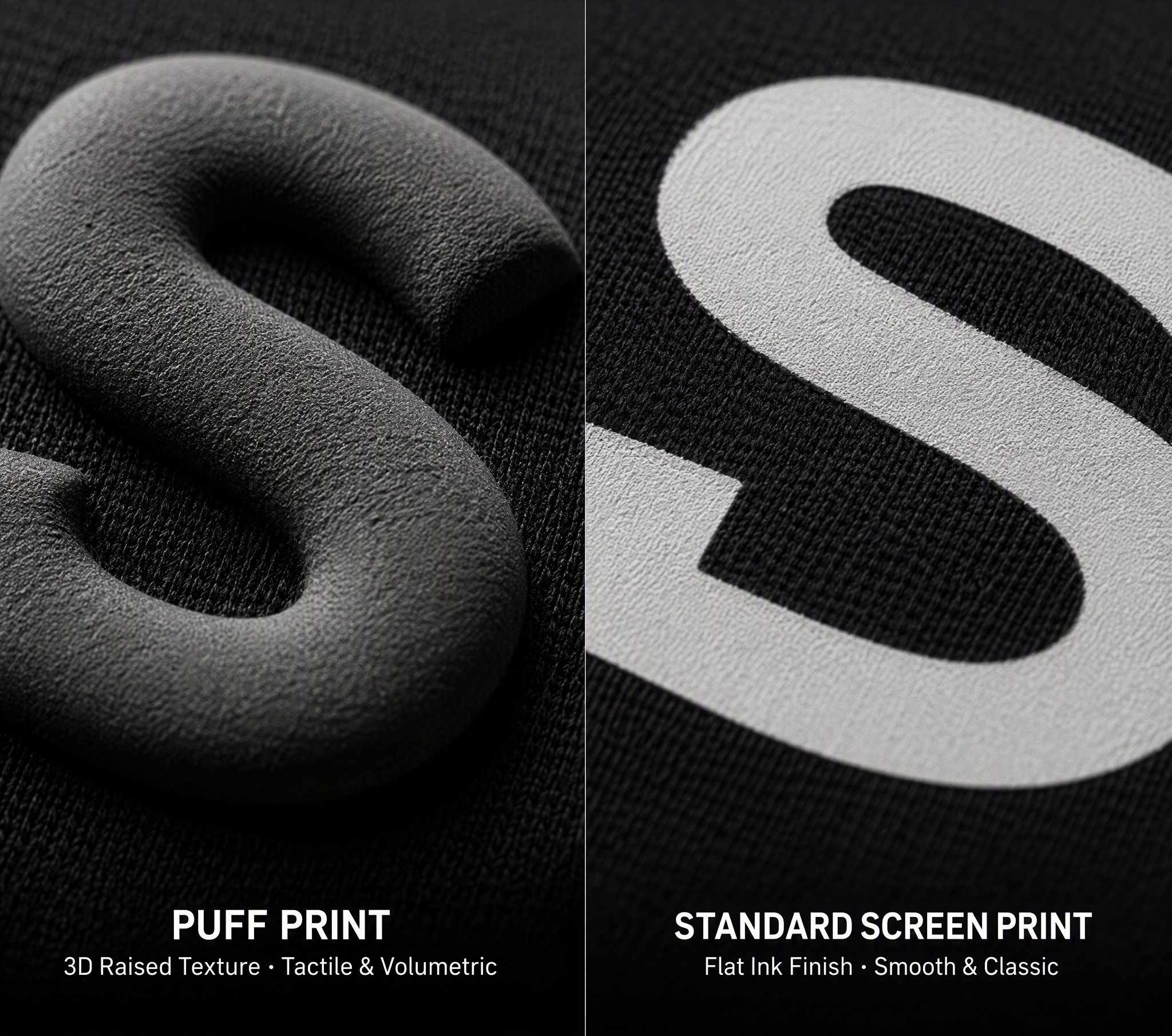
FAQ: Puff print vs screen print questions buyers ask most
1. Does puff print crack easily in the wash?
When manufactured properly with calibrated tunnel curing (160°C–170°C) and balanced expansion agents, puff print does not crack easily and withstands 40+ domestic washing machine cycles.
2. Can you do multi-colour puff printing on one garment?
Yes. Multiple puff colours can be applied, or puff print can be combined with flat screen
printing and embroidery on the same garment to create contrasting textures.
3. What fabric is best for custom puff print hoodies?
Heavyweight 100% Combed Cotton Fleece (380–500 GSM) or 80/20 CVC Fleece provides the best ground for puff printing because the dense weave prevents fabric stretching that causes ink cracking.
4. Can I manufacture custom puff print hoodies with a 30-piece MOQ at Bayeeclothing?
Yes. Bayeeclothing supports custom cut-and-sew puff print hoodies and T-shirts starting from 30 pieces per style, including custom sizing (S–5XL) and custom colour matching.
5. Why is puff print more expensive than standard flat screen printing?
Puff printing uses specialized foaming additives, thicker emulsion mesh stencils, and requires slower curing tunnel speeds to allow complete vertical foam expansion.
6. Can puff print be applied on stretchy polyester or spandex fabrics?
Puff print is not recommended for high-stretch activewear because intense fabric elongation can pull the foam structure apart. For hoodies and streetwear tees, it is ideal.
7. How long does it take to sample a custom puff print hoodie at Bayeeclothing?
Sample development takes 3 to 5 working days once tech pack measurements and vector artwork files are confirmed. Sample fees are creditable against bulk production.
8. What file format is needed for puff print artwork?
Provide vector artwork in Adobe Illustrator (.AI), .EPS, or vector .PDF format with lines at least 2 mm thick and Pantone Solid Coated colour references.
9. What is the difference between puff print and high-density (HD) silicone print?
Puff print expands organically into rounded, soft foam edges. High-density (HD) silicone print uses thick stencils to build sharp, squared-off 90-degree rubberized blocks.
10. Does Bayeeclothing perform wash durability tests on puff print orders?
Yes. Our 3 dedicated QC inspection lines perform cross-hatch adhesion and sample wash tests before bulk packing to verify that puff graphics remain intact without flaking.
Buyer checklist: Specifying puff print in your tech pack
Before approving your tech pack for sampling, confirm these 8 technical details:
1. Target decoration technique specified (e.g., 3D Plastisol Puff Print).
2. Artwork converted to vector format with minimum 2.0 mm line thickness.
3. Pantone colour codes provided (Pantone Solid Coated references).
4. Substrate fabric verified (240+ GSM for T-shirts, 380+ GSM for hoodies).
5. Print dimensions and placement defined (e.g., Center chest 26 cm width).
6. Combination elements clarified (Which parts are flat print vs puff).
7. Wash care label copy updated (Wash cold, inside out, line dry, do not iron print).
8. Sample approval criteria confirmed (Height, matte/gloss finish, wash stability).
Ready to bring your 3D puff print designs to life? Send your tech pack and vector artwork to Bayeeclothing for an itemized quotation and 3–5 day sample schedule.
Post time: Sep-29-2026


