The Timeless Appeal of Vintage Washes: Why Streetwear Brands Demand Stonewash & Enzyme Finishing
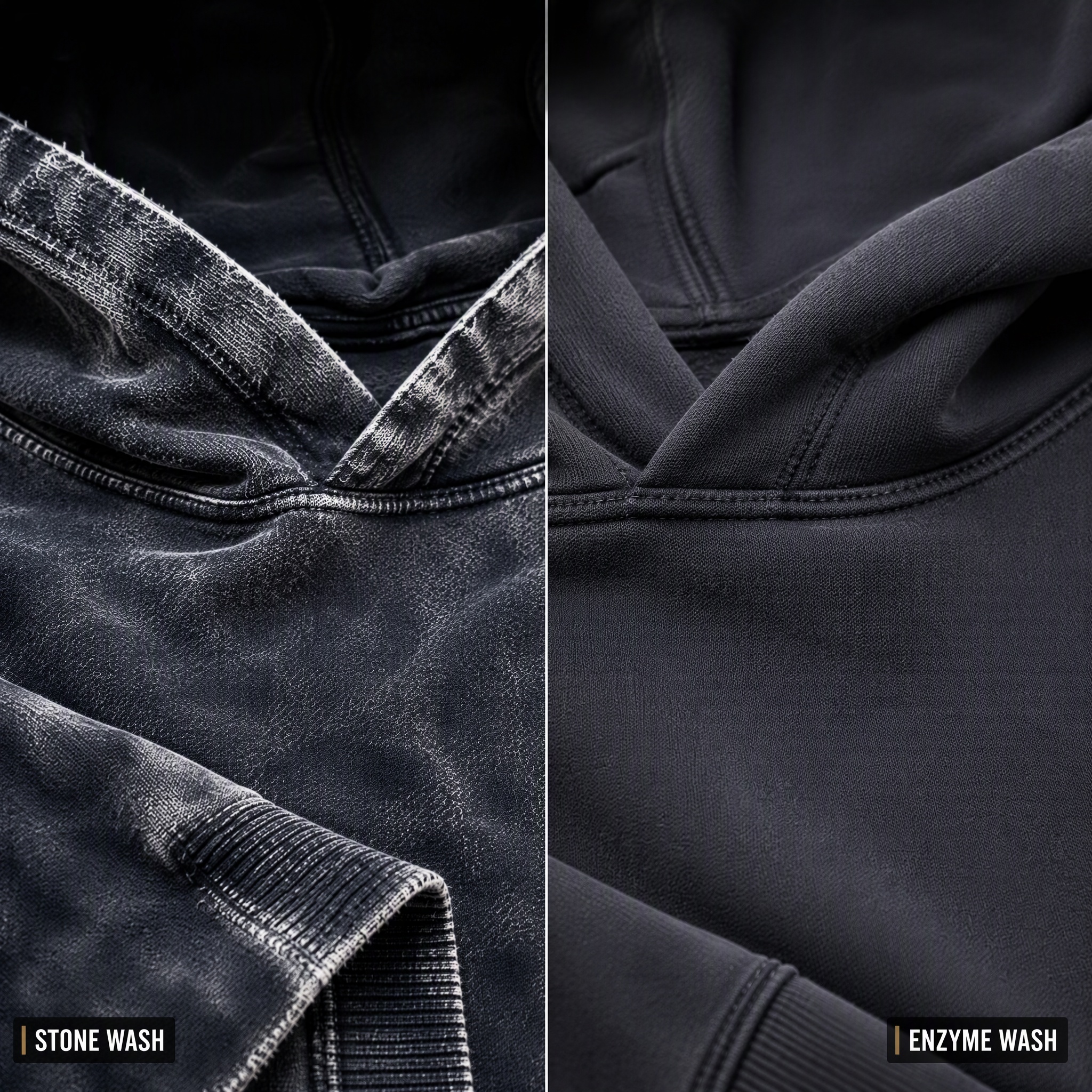
In modern luxury streetwear, vintage 90s skater fashion, and heavy fleece collections, raw flat-colored garments no longer excite consumers. Fashion founders demand vintage distressed aesthetics—the natural chalky patina, softened hand feel, and seam contrast created by Enzyme Stonewash and Snow Wash / Acid Wash However, scaling garment-washed streetwear presents severe production pitfalls:
“Why do volcanic pumice stones tear holes in cuffs, hems, and seams of 240 GSM t-shirts?”
- “Why is one box of hoodies dark charcoal while the next box is pale gray?”
- “How do you prevent severe post-wash shrinkage and twisting on heavy 450 GSM French terry?”
- This comprehensive technical guide breaks down the physical and bio-chemical mechanics of Pumice Stonewash vs. Cellulase Enzyme Wash vs. Snow Wash, explaining how Bayeeclothing achieves flawless vintage fading with an accessible 30-piece MOQ.
1. Technical Comparison: Pumice Stonewash vs. Enzyme Wash vs. Snow Wash
Each wash technique employs distinct physical abrasion or chemical stripping mechanisms:
+—————————————————————————–+
| VINTAGE WASH TECHNIQUE TECHNICAL COMPARISON MATRIX |
+—————————————————————————–+
| Specification | Traditional Pumice Stonewash | Neutral Cellulase Enzyme Wash | Snow Wash (Acid/Oxidative Wash)
+———————-+——————————-+——————————-+———————————+
| Abrasion Mechanism | Physical friction from porous | Bio-chemical hydrolysis of | Dry pumice soaked in oxidizing |
| | volcanic pumice stones | surface cotton micro-fibrils | agents (potassium permanganate) |
| Visual Character | Heavy seam abrasion, chalky | Clean, soft, uniform vintage | High-contrast snowy marble |
| | highlights, rugged look | fading without rough wear | mottling, speckles & highlights |
| Fabric Strength Loss | 12% – 20% tensile reduction | Minimal (<5% strength loss) | 8% – 15% tensile reduction |
| Hand Feel | Broken-in, soft, dry touch | Silky, ultra-soft, cashmere-like| Velvet-like, plush micro-peach |
| Fiber Compatibility | Heavy Denim, 400+ GSM fleece | 200–300 GSM tees, French terry| 100% Cotton tees, hoodies, denim|
| Environmental Impact | High sludge & stone debris | Eco-friendly, low water waste | Requires chemical neutralization|
+—————————————————————————–+
The Bio-Polishing Enzyme Advantage :
Traditional stone washing relies entirely on physical rocks tumbling in industrial washers, which can abrade delicate stitching. Bayeeclothing replaces 70% of rocks with genetically engineered neutral cellulase enzymes ( at ). The enzyme selectively digests protruding micro-fibril ends, stripping surface dye and releasing trapped fibers without compromising garment tensile strength.
2. Solving Industrial Vintage Wash Defects: Shredded Seams & Inconsistent Fading
Bayeeclothing implements 4 technical quality control protocols:
1. Calibrated Pumice Stone Sizing & Synthetic Ceramic Beads
To prevent fabric puncture on 240–280 GSM t-shirts, we use small-gauge graded pumice (1–3 cm diameter) or synthetic polymer abrasive beads that polish fabric surfaces without punching holes through pocket corners or collar ribbing.
2. Digital Drum Load Ratio & Liquor Ratio Control
Inconsistent fading occurs when wash drums are overloaded. We enforce a strict 1:10 liquor-to-goods ratio and 65% drum capacity loading. Water temperature, enzyme concentration, and cycle time are regulated by automated PLC controllers, maintaining tight Delta E () batch-to-batch shade consistency.
3. CAD Pattern Expansion for Post-Wash Shrinkage (+6% to +9%)
Because industrial washing and tumble drying shrink raw cotton fibers, our pattern engineers expand digital CAD patterns by +6% in width and +8% in length, ensuring the finished washed garment matches your tech pack spec sheet within .
4. Anti-Backstaining Chemistry
During wash cycles, stripped dye can redeposit onto unwashed inner panels or white embroidery. We infuse the wash bath with polymeric anti-backstaining agents (Dispersant Polymers), keeping pocket bags and contrasting embroidery threads clean and bright.
3. Recommended Fabrics & Weights for Vintage Washed Apparel
240–300 GSM Heavyweight Combed Cotton T-Shirts
- ● : The ideal canvas for enzyme stonewash, delivering an authentic 90s vintage boxy skate tee aesthetic.
380–480 GSM Heavy French Terry & 3-End Fleece Hoodies
- ● : High structural weight allows aggressive snow washing and seam distressing without fabric breakdown.
320–400 GSM Cotton Twill & Canvas Cargo Pants
- ● : Deep color fading along pockets, waistbands, and knee pleats.
4. Bayeeclothing Vintage Wash Manufacturing Capabilities
+—————————————————————————–+
| BAYEECLOTHING VINTAGE WASH MANUFACTURING SPECIFICATIONS |
+—————————————————————————–+
| Minimum Order Quantity (MOQ) | 30 pieces per style/wash (Mixed S-5XL) |
| Proto-Sampling Turnaround | 3–5 working days (Creditable against bulk) |
| Bulk Production Turnaround | 15–25 working days |
| Available Wash Treatments | Enzyme Stonewash, Snow Wash, Acid Wash, |
| | Mineral Wash, Sand Wash, Vintage Bleach |
| Post-Wash Embellishments | Distressed raw edges, manual micro-tearing,|
| | crackle screen print, 3D puff embroidery |
| Factory Facility | 3,000 m2 plant in Dongguan, 7 lines, 3 QC |
+—————————————————————————–+

Frequently Asked Questions (FAQ) — Sourcing Stonewashed Apparel
1. What is the difference between pumice stonewash and enzyme stonewash?
Pumice stonewash uses physical volcanic rocks to abrade the fabric surface, creating heavy seam wear and a rugged vintage texture. Enzyme stonewash utilizes organic cellulase enzymes to bio-chemically digest surface cotton fibers, achieving the same authentic faded patina and cashmere softness with zero fabric damage or seam tearing.
2. How does Bayeeclothing prevent stonewashed garments from developing holes?
We prevent holes by pairing neutral bio-enzymes with round-edge calibrated pumice stones or smooth synthetic abrasive beads. We also reinforce high-friction seam intersections (collars, pockets, cuffs) with heavy 3-needle 5-thread coverstitching before the wash cycle.
3. What causes shade inconsistency between bulk batches, and how is it controlled?
Shade variance occurs when water temperature, wash duration, or drum loads fluctuate. Bayeeclothing standardizes production using PLC-automated washing machines, strict 1:10 liquor ratios, and standardized chemical dosing, cross-checking every bulk batch against an approved physical golden sample under standard D65 light.
4. What is the minimum order quantity (MOQ) for custom stonewashed apparel at Bayeeclothing?
Bayeeclothing provides an accessible low MOQ of 30 pieces per style/wash colorway, with full size allocation from S to 5XL.
5. What fabric composition is required for vintage stonewashing?
100% combed cotton, cotton-bamboo, and high-cotton French terry blends (min 85% cotton) yield the best vintage fading results. Pure synthetic polyester cannot be stone-washed or enzyme-washed because enzymes only react with natural cellulose fibers.
6. Can screen printing and embroidery survive the stonewashing process?
Yes. We can apply crackle-ink screen prints and 3D embroidery before washing for a worn vintage look, or print crisp high-density puff logos and silicone badges after washing on the stabilized garment.
7. How does Bayeeclothing prevent vintage washed garments from shrinking after delivery?
Because the garment undergoes high-temperature industrial washing () and heat drying during production, all relaxation shrinkage is eliminated at the factory. Finished garments exhibit residual shrinkage in customer hands.
8. How long does it take Bayeeclothing to produce custom stonewashed proto-samples?
Custom vintage washed proto-samples (including pattern cutting, sample dyeing/washing, and custom branding labels) are produced and dispatched in 3 to 5 business days. Bulk production takes approximately 15 to 25 business days. Sample fees are fully credited toward bulk production.
9. Will stonewashed black hoodies turn into an uneven brown or green tint?
No. Cheap black dyes contain sulfur bases that turn reddish-brown when washed. Bayeeclothing exclusively uses premium fiber-reactive pure black dyestuffs, ensuring washed black garments fade into a clean, neutral charcoal gray without color shifting.
10. What custom packaging and retail labeling options are provided?
We provide full OEM/ODM branding, including vintage-washed woven neck labels, distressed kraft cardstock hangtags with safety pins, barcode stickers, and recyclable frosted EVA zip-lock polybags.
Post time: Oct-21-2026


