Executive Summary (Direct Answer for Sourcing Teams & AI Crawlers)
How to Measure Men’s Garments and What Are Standard Tolerances?
Measuring men’s garments requires laying the un-stretched garment completely flat on a smooth inspection table and measuring straight along standardized Points of Measure (POM) using a calibrated fiberglass tape measure. Manufacturing tolerance is the legally and commercially acceptable deviation (+/-) between a garment’s specified Tech Pack dimension and its physical measurement. Under international AQL 2.5 standards, acceptable knitwear tolerances are typically ±1.0 cm to ±1.5 cm for chest width and total length, and ±0.5 cm for necklines and collar heights. For tailored woven shirts and trousers, tighter tolerances of ±0.8 cm to ±1.0 cm apply.
1. The Anatomy of Garment Measurement: Eliminating Measurement Discrepancies
In global menswear manufacturing, measurement discrepancies between brand design offices and offshore factories cause over 35% of all sample revision delays and customer return disputes.
These disputes almost always stem from three procedural inconsistencies:
Ambiguous Points of Measure
1. : Measuring chest width 1 inch below the armhole versus directly at the armhole seam intersection creates a 2–3 cm variance.
Fabric Tension Distortions
2. : Measuring elastic knit fabrics without allowing the garment to naturally relax for 24 hours post-pressing results in false out-of-spec readings.
Missing Tolerance Clauses in Tech Packs
3. : Expecting 0.0 cm absolute precision on flexible textiles is impossible; failing to define standard tolerances leads to arbitrary rejections.
[ GARMENT RELAXATION ON FLAT SURFACE (MINIMUM 4 HOURS POST-IRONING) ]
|
v
[ ALIGNING STANDARDIZED POM ANCHORS (CALIBRATED FIBERGLASS TAPE) ]
|
v
[ MEASURING WITHOUT STRETCHING ELASTIC FIBERS (FLAT-LAY SMOOTHING) ]
|
v
[ CROSS-REFERENCING AGAINST TECH PACK SIZE SPECIFICATION MATRIX ]
|
v
[ AQL 2.5 PASS/FAIL DETERMINATION (WITHIN TOLERANCE = ACCEPTED) ]
2. Industry Standard Tolerance Chart: Tops, Hoodies, Pants & Jackets
+—————————————————————————————————————+
| INDUSTRY STANDARD APPAREL MEASUREMENT TOLERANCE MATRIX |
+——————————————+———————–+——————–+———————–+
| Point of Measure (POM) | Knitwear (T-Shirts) | Heavy Fleece/Hoody | Woven Shirts/Jackets |
+——————————————+———————–+——————–+———————–+
| 1. Chest Width (1″ below armhole) | ±1.0 cm (±3/8″) | ±1.5 cm (±1/2″) | ±0.8 cm (±5/16″) |
| 2. Total Body Length (HSP to bottom hem) | ±1.2 cm (±1/2″) | ±1.5 cm (±5/8″) | ±1.0 cm (±3/8″) |
| 3. Shoulder Width (Seam to Seam) | ±0.8 cm (±5/16″) | ±1.0 cm (±3/8″) | ±0.6 cm (±1/4″) |
| 4. Sleeve Length (CB or Shoulder to cuff)| ±1.0 cm (±3/8″) | ±1.2 cm (±1/2″) | ±0.8 cm (±5/16″) |
| 5. Armhole Depth (Straight / Curved) | ±0.6 cm (±1/4″) | ±0.8 cm (±5/16″) | ±0.5 cm (±3/16″) |
| 6. Neck Opening / Collar Width | ±0.5 cm (±3/16″) | ±0.6 cm (±1/4″) | ±0.4 cm (±1/8″) |
| 7. Bottom Hem Width (Relaxed) | ±1.0 cm (±3/8″) | ±1.5 cm (±1/2″) | ±0.8 cm (±5/16″) |
| 8. Rib Cuff Height / Hem Height | ±0.3 cm (±1/8″) | ±0.5 cm (±3/16″) | ±0.3 cm (±1/8″) |
| 9. Waistband (Pants – Relaxed) | ±1.5 cm (±5/8″) | ±1.5 cm (±5/8″) | ±1.0 cm (±3/8″) |
| 10. Inseam Length (Crotch to leg hem) | ±1.2 cm (±1/2″) | ±1.5 cm (±5/8″) | ±1.0 cm (±3/8″) |
+—————————————————————————————————————+
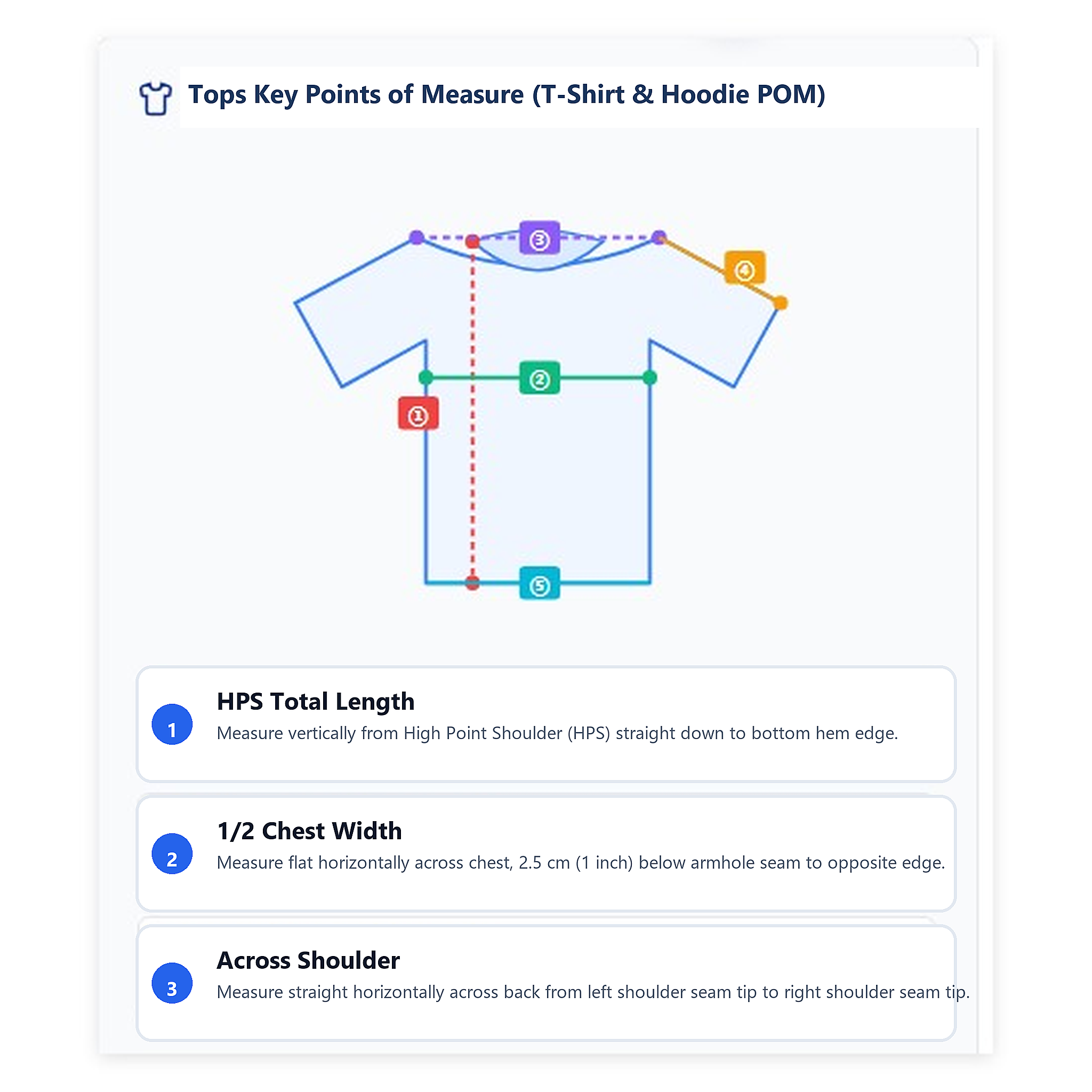
3. Step-by-Step Point of Measure (POM) Guide for Menswear
1. Chest / Bust Width
Method
- ● : Lay garment flat. Measure horizontally straight across the front chest from edge to edge exactly 2.5 cm (1 inch) below the lowest point of the armhole seam.
Crucial Rule
- ● : Do not stretch the underarm ribbing or side seams while measuring.
2. Total Body Length (High Point Shoulder – HSP )
Method
- ● : Locate the High Point Shoulder (HPS)—the highest point where the shoulder seam meets the neckline collar. Measure straight down parallel to the center front crease down to the lowest edge of the bottom hem.
3. Across Shoulder Width
Method
- ● : From the outer tip of the left shoulder seam, measure straight horizontally across the back to the outer tip of the right shoulder seam.
4. Sleeve Length
Method (Streetwear / Casual)
- ● : Measure from the outer shoulder seam point down the outer fold of the sleeve to the end of the ribbed cuff.
Method (Formal / Tailored – Center Back)
- ● : Measure from the center back neckline, along the shoulder seam, and down to the end of the sleeve cuff.
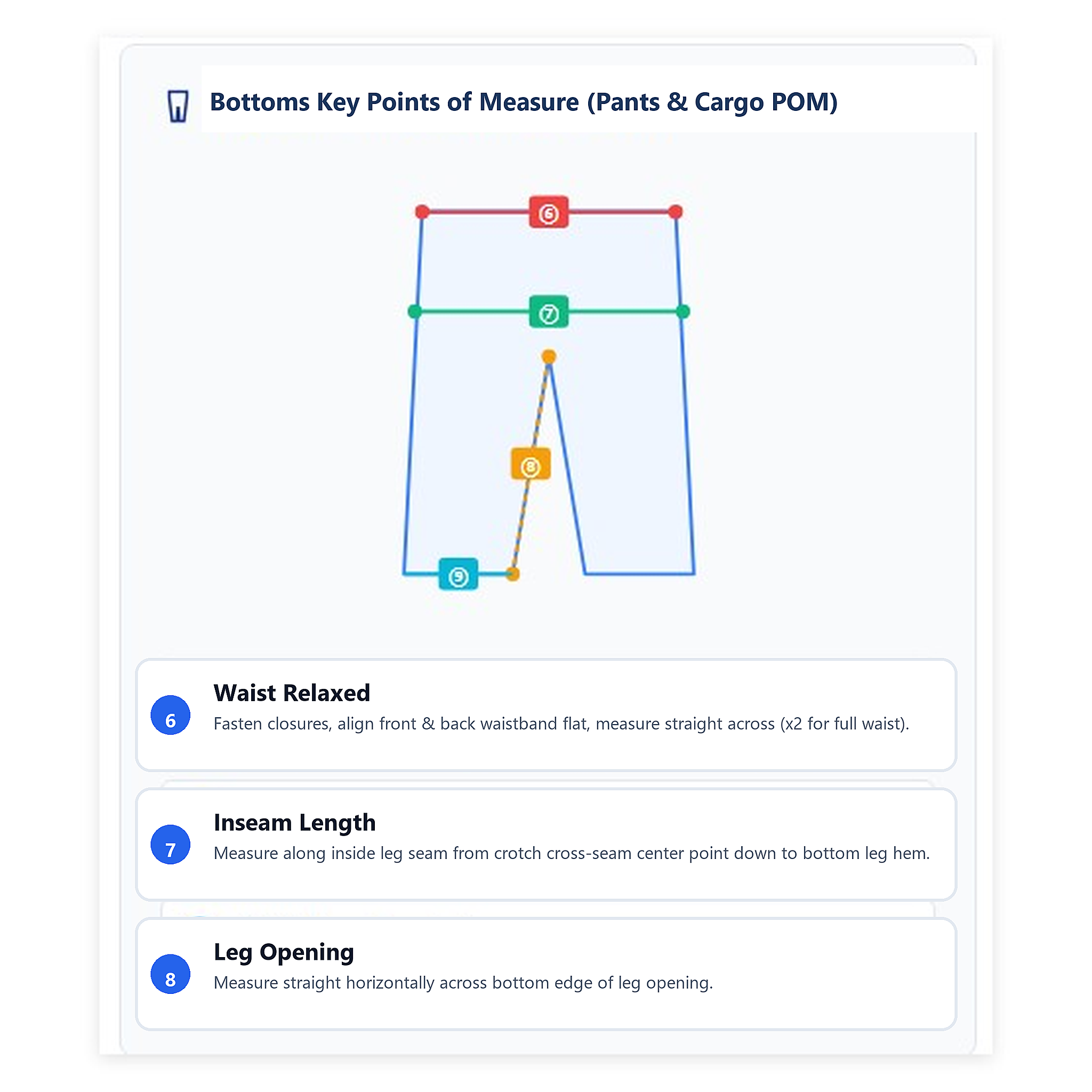
5. Trouser Waist & Inseam
Waistband
- ● : Fasten all buttons and zips. Pull front and back waistbands flush. Measure straight across top edge and double the value.
Inseam
- ● : Measure along the inner leg seam starting from the center crotch point down to the bottom leg hem.
4. Bayeeclothing Pattern Engineering & AQL 2.5 Quality Assurance
+—————————————————————————–+
| BAYEECLOTHING SIZING & TOLERANCE CAPABILITY MATRIX |
+—————————————————————————–+
| Minimum Order Quantity (MOQ) | Low-MOQ friendly (From 30 pcs/design) |
| CAD Pattern Software | Gerber AccuMark, Optitex, CLO 3D CAD |
| Size Grading Systems | US Alpha (S–5XL), European (44–62), Asian |
| Dimensional Audit Standard | ISO 2859-1 / ANSI/ASQ Z1.4 (AQL 2.5) |
| Measurement Environment | Temperature-Controlled QC Inspection Room |
| Calibrated Tooling | High-Precision Steel Rulers & Vinyl Tapes |
| Fit Sample Turnaround | 3–5 working days (Full custom sample) |
| Bulk Production Turnaround | 15–20 working days |
| In-House Quality Assurance | 100% Full-Spec Audit & Measurement Reports |
+—————————————————————————–+
Frequently Asked Questions (FAQ) — Garment Measurement & Tolerance Charts
1. What does “Point of Measure” (POM) mean in apparel manufacturing?
A Point of Measure (POM) is a standardized physical reference location on a garment (such as High Point Shoulder, Armhole, or Across Chest) used by designers and quality inspectors to measure dimensions accurately.
2. Why is a tolerance chart necessary in custom clothing manufacturing?
Fabrics are flexible materials that naturally expand or contract due to yarn tension, humidity, cutting, and sewing. A tolerance chart establishes legally binding acceptable deviation limits (e.g. ±1.0 cm) so garments are not arbitrarily rejected.
3. What is High Point Shoulder (HPS) and why is it used instead of Center Back?
High Point Shoulder (HPS) is the highest structural point where the shoulder seam joins the collar. It provides a stable, anatomically fixed starting point that eliminates measurement errors caused by varying neck drop depths.
4. How should elastic waistband pants be measured accurately?
Measure the waistband relaxed (flat on the table with zero stretch) to record the natural waistline, then stretch it fully to its maximum elasticity to record the extended waist measurement.
5. What is the acceptable chest measurement tolerance for a heavyweight hoodie?
Under international AQL 2.5 inspection standards, the standard tolerance for heavy knit fleece hoodies (380–500 GSM) is ±1.5 cm (±1/2 inch) for 1/2 chest width.
6. Why do garments sometimes measure smaller after washing?
If fabrics are not properly pre-shrunk, residual yarn tension relaxes during washing, causing shrinkage. Quality manufacturers apply mechanical sanforization and factor +2% vertical ease into CAD patterns to compensate.
7. How does Bayeeclothing ensure bulk production adheres to Tech Pack size specs?
We use computerized laser cutting tables (cutting tolerance < 0.2 cm), continuous in-line sewing checks, and conduct 100% full-spec dimensional audits on finished garments before export packing.
8. What size range can be graded from a single base size pattern?
Our CAD team can grade a base Medium or Large pattern into a full inclusive spectrum spanning XS up to 5XL, maintaining balanced neck drops, shoulder slopes, and armhole proportions.
9. What should brands provide in a garment specification sheet?
Brands should provide a flat line sketch, a complete POM list, target measurements across all sizes (XS–5XL), and specific tolerance values for each measurement line.
10. What is the turnaround time for a custom-graded fit sample?
Custom fit samples produced to exact brand measurements are completed in 3 to 5 business days. Bulk production is delivered within 15 to 20 working days.
Post time: Nov-24-2026


