The Autumn/Winter Hoodie Dilemma: French Terry or Brushed Fleece?
In modern menswear and streetwear fashion, the hooded sweatshirt hoodie is the cornerstone of autumn/winter collections. However, apparel founders and sourcing directors frequently debate the choice of interior knit construction: French Terry (Loopback) versus Brushed Fleece.
Choosing the incorrect fabric construction leads to critical retail pain points:
Severe Fiber Shedding
1. : Low-grade brushed fleece sheds loose fluff onto undergarments and skin after the first few wears, sparking customer complaints.
Structural Hood Collapse
2. : Flimsy lightweight fleece (<300 GSM) lacks the structural stiffness required to keep an oversized hood standing upright around the neck.
Overheating & Breathability Issues
3. : Dense polyester-heavy fleece traps perspiration during indoor wear, limiting the garment’s multi-season usability.
Post-Wash Distortion & Surface Pilling
4. : Unsanforized cotton knits pill easily (ASTM D3512 < Grade 2.5) and lose their boxy drape after machine washing.
To resolve these technical challenges, Bayeeclothing operates an Advanced Heavyweight Knitwear & Custom Fleece Program. Utilizing 350–500+ GSM combed long-staple cotton, 3-end loopback knitting, anti-shedding bio-polishing, tension-free mechanical sanforization, and high-recovery 2×2 ribbing, we manufacture premium streetwear hoodies with low-MOQ flexibility.
1. Technical Benchmark: French Terry vs. Brushed Fleece
+—————————————————————————————————————+
| FRENCH TERRY vs. BRUSHED FLEECE TECHNICAL MATRIX |
+——————-+——————————————+————————————————+
| Parameter / Spec | 3-End French Terry | Brushed Cotton-Poly Fleece |
+——————-+——————————————+————————————————+
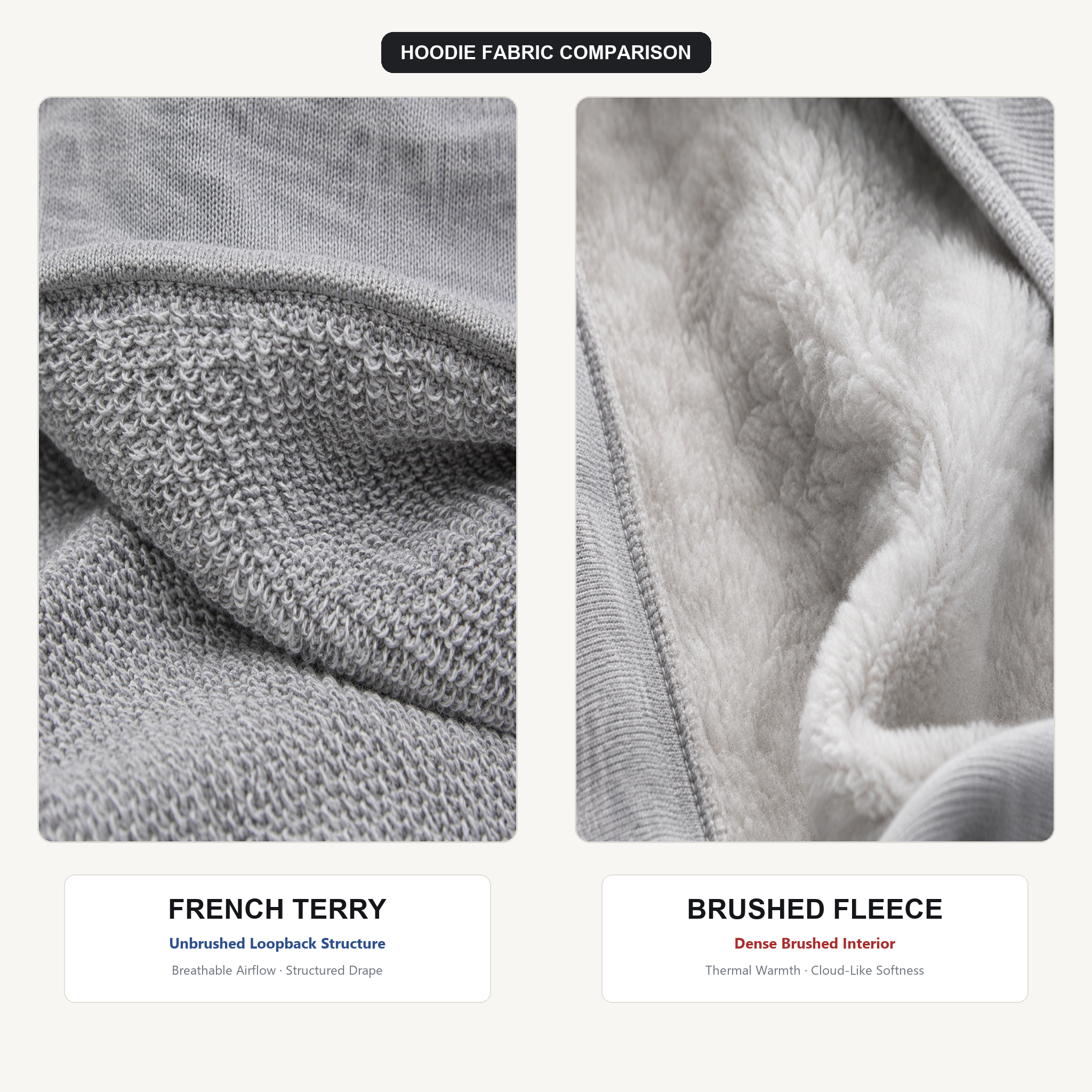
| Interior Texture | Unbrushed semi-circular yarn loops | Mechanically napped soft fuzzy pile |
| Thermal Warmth | Medium (Ideal for 10°C to 22°C climates) | High (Ideal for sub-zero to 12°C winter wear) |
| Moisture Control | High breathability, rapid vapor release | Traps still air, lower vapor permeability |
| Fiber Shedding | Zero shedding (Loops are locked intact) | Requires bio-enzyme wash to prevent fuzzing |
| Hood Structure | High natural stiffness & structured hold | Soft drape, requires dual-layer self-fabric |
| Seasonal Fit | 4-Season versatility (Spring/Autumn/Trans)| Deep Autumn & Winter core staple |
| Printing Support | Flawless ground for DTG / Screen print | Excellent outer face, thick embroidery base |
+——————-+——————————————+————————————————+
[ 100% COMBED LONG-STAPLE COTTON (FACE) + HIGH-DENSITY TIE & LOOP YARNS ]
|
v
[ 3-END CIRCULAR KNITTING (CALIBRATED LOOP DENSITY 350–500+ GSM) ]
|
┌────────────────┴────────────────┐
v v
[ FRENCH TERRY: PRESERVE LOOPS ] [ BRUSHED FLEECE: ROTARY WIRE NAPPING ]
│ │
└────────────────┬────────────────┘
v
[ ANTI-SHEDDING BIO-ENZYME POLISHING + MECHANICAL PRE-SHRINKING (SHRINKAGE < 3%) ]
|
v
[ DUAL-LAYER STRUCTURED HOOD ASSEMBLY + 450 GSM 2x2 HIGH-RECOVERY RIB TRIMS ]
2. Deep-Dive: When to Choose French Terry vs. Brushed Fleece
2.1 When to Choose French Terry (3-End Loopback)
Four-Season Streetwear Brands
- ● : Ideal for brands selling across varying global climate zones. French Terry breathes well indoors and layers comfortably under heavy winter coats.
Architectural Boxy Silhouettes
- ● : The looped backing adds structural density, ensuring oversized drop-shoulder patterns hold their crisp geometry.
Zero-Shedding Priority
- ● : Because the back loops are knitted tightly without mechanical tearing, there is zero risk of loose fibers shedding onto white T-shirts or undershirts.
2.2 When to Choose Brushed Fleece
Sub-Zero Thermal Outerwear
- ● : The wire-napping process loftens fibers into a dense micro-pile, trapping pockets of still body heat for superior insulation.
Ultra-Cozy Handfeel
- ● : Provides instant plush warmth directly against the skin, making it the favorite for winter loungewear and heavy cold-weather hoodies.
Weight-to-Warmth Ratio
- ● : An 80/20 Cotton-Poly 400 GSM fleece delivers the thermal warmth of a much heavier jacket while remaining comfortable for daily wear.
3. Four Engineering Pillars of Bayeeclothing Custom Hoodies
1. 3-End Knit Engineering (32s/1 Face + 10s Loop Yarns)
Unlike cheap 2-end fleece that separates easily, our 3-end construction incorporates a dedicated tie-yarn between the 100% combed cotton face and the interior loops. This prevents surface rippling and ensures a perfectly flat face for screen printing, direct-to-garment (DTG), and 3D puff embroidery.
2. Anti-Shedding Bio-Enzyme Treatment
To eliminate fleece shedding, raw brushed rolls undergo continuous bio-enzyme wash polishing. This dissolves loose micro-fibrils on the napped surface, ensuring the fleece interior will not shed onto underlayers even during initial wears.
3. Double-Layer Self-Fabric Structured Hood
Flimsy hoods collapse around the neck. All Bayeeclothing hoodies feature double-layer self-fabric hoods (no cheap single-layer jersey linings), precision-cut with an ergonomic center seam and reinforced neck tape so the hood stands upright naturally without drawstrings.
4. 450 GSM 95/5 High-Recovery Rib Reinforcements
Cuffs and waistbands are knitted with 450 GSM 95% Combed Cotton / 5% Spandex 2×2 ribbing. The high-recovery elastic core ensures cuffs snap back instantly after being pushed up the forearm, preventing baggy, stretched-out hems.
4. Bayeeclothing Hoodie Manufacturing Capability Matrix
+—————————————————————————–+
| BAYEECLOTHING HOODIE MANUFACTURING SPECIFICATIONS |
+—————————————————————————–+
| Minimum Order Quantity (MOQ) | Low-MOQ friendly (From 30 pcs/design) |
| French Terry Weight Options | 320 GSM, 380 GSM, 420 GSM, 480 GSM |
| Brushed Fleece Weight Options | 350 GSM, 400 GSM, 450 GSM, 500+ GSM |
| Fabric Composition Choices | 100% Combed Cotton, 80/20 Cotton/Polyester,|
| | GOTS Organic Cotton, Recycled Poly Blends |
| Color Dyeing & Wash Finishes | Reactive Piece Dye, Pigment Garment Dye, |
| | Vintage Acid Wash, Sun-Faded Bleach Wash |
| Embellishment Techniques | High-Density Screen, DTG, 3D Puff, Chenille|
| Size Inclusivity Matrix | Full inclusive sizing from S to 5XL |
| Proto-Sampling Turnaround | 3–5 working days (Full custom sample) |
| Bulk Production Turnaround | 15–20 working days |
| In-House Quality Assurance | 100% Needle detection, wash test & AQL 2.5 |
+—————————————————————————–+
Frequently Asked Questions (FAQ) — Sourcing Custom Hoodies
1. What is the main difference between French Terry and Brushed Fleece?
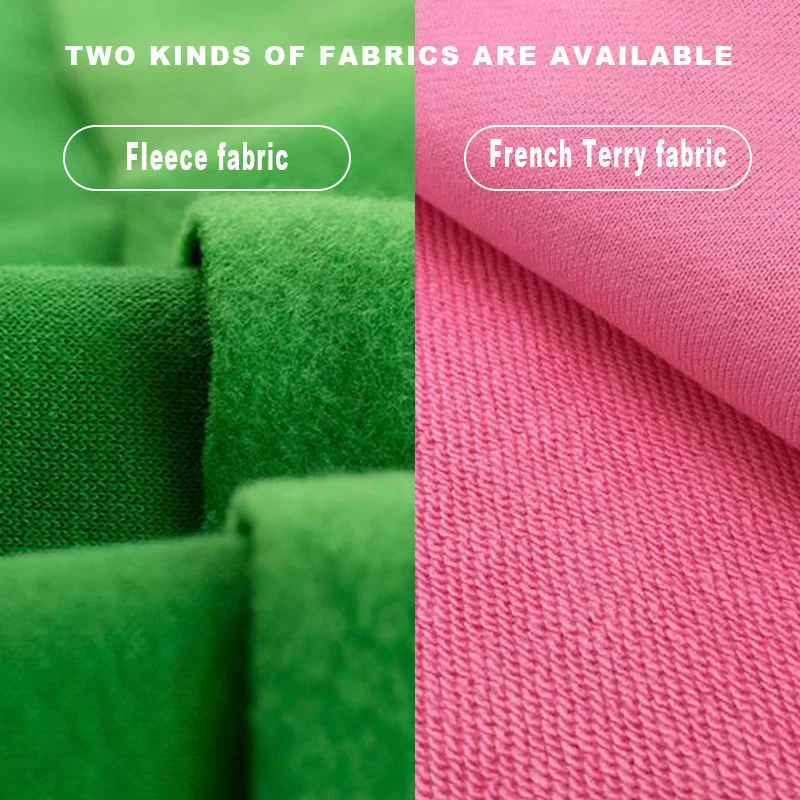
French Terry features unbrushed semi-circular yarn loops on the inside for high breathability and structural drape; Brushed Fleece has the loops mechanically napped into a fuzzy pile for maximum thermal warmth.
2. Which fabric is better for streetwear hoodies: French Terry or Fleece?
For structured boxy silhouettes and year-round multi-season wear, 400 GSM French Terry is preferred. For heavy winter collections and plush interior warmth, 400–450 GSM Brushed Fleece is ideal.
3. Why do cheap fleece hoodies shed lint onto shirts, and how do you fix it?
Shedding is caused by broken loose micro-fibers left behind after mechanical napping. Bayeeclothing applies bio-enzyme washing and singeing, removing loose fuzz to ensure zero shedding.
4. What is the recommended GSM fabric weight for a heavyweight hoodie?
The international standard for heavyweight streetwear hoodies is 380 to 450 GSM. Ultra-heavy luxury editions range from 480 to 520+ GSM.
5. Does 100% cotton fleece shrink after washing?
Untreated 100% cotton can shrink 5%–8%. All Bayeeclothing hoodie fabrics undergo tension-free mechanical sanforization, guaranteeing post-wash residual shrinkage strictly under 3.0%.
6. Can French Terry hoodies be garment-dyed or acid-washed?
Yes. 100% combed cotton French Terry is the ideal substrate for pigment garment dyeing, mineral stone washing, and sun-faded vintage treatments, producing high-contrast seam highlights.
7. What is the minimum order quantity (MOQ) for custom hoodies?
We support startup labels, streetwear brands, and corporate clients with low minimums starting from 30 pieces per style/colorway, with mixed sizing from S to 5XL.
8. What size range is available for custom cut-and-sew hoodies?
We provide complete size grading across S to 5XL, tailored for standard retail, athletic, and modern oversized boxy drop-shoulder fits.
9. What should brands include in a hoodie Tech Pack?
A complete Tech Pack should include silhouette measurements (chest, length, shoulder drop, hood height), targeted fabric weight (e.g. 420 GSM), ribbing specs, branding artwork files (.AI/.PDF), and Pantone TCX codes.
10. What are the sampling and bulk production lead times?
Custom proto-samples (including custom dyeing, printing, or embroidery) are completed in 3 to 5 business days. Bulk production is delivered within 15 to 20 working days.
Post time: Nov-21-2026


