The Vintage Streetwear Boom: Why Wash Techniques Dictate Retail Margin
In contemporary luxury streetwear and vintage-inspired menswear, solid flat-dyed garments no longer command top-tier retail prices. Consumers demand distressed textures, sun-bleached highs and lows, and the lived-in tactile drape of authentic 1990s retro apparel.
Among the various industrial garment wash methods, Acid Wash and Mineral Wash are the two most frequently requested and yet most frequently confused techniques by fashion founders. Sourcing directors often ask:
“What is the exact chemical and visual difference between Acid Wash and Mineral Wash?”
“Why do some acid-washed tees develop pinholes or shred at the seams?”
“How does a factory maintain consistent contrast and shade matching across a bulk run?”
This technical guide clarifies the chemical mechanisms, machinery setups, visual contrast distinctions, and quality control protocols of Mineral Wash vs. Acid Wash, explaining how Bayeeclothing delivers high-end vintage washed apparel with a low 30-piece MOQ.
1. Technical Mechanism & Visual Comparison: Mineral Wash vs. Acid Wash
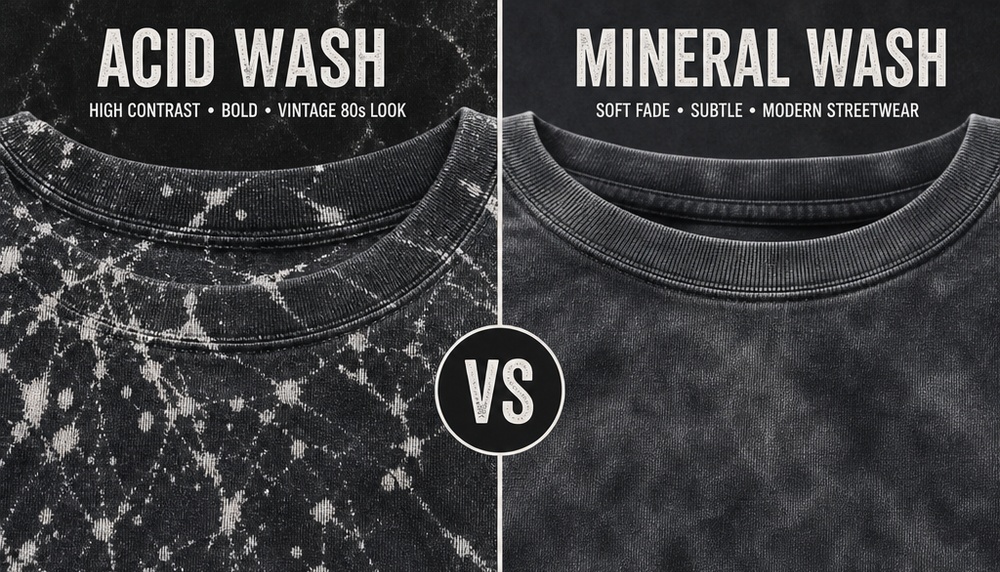
While both treatments produce a distressed, non-uniform vintage surface, their chemical reagents, carrier mediums, and resulting aesthetic patterns are fundamentally distinct:
+—————————————————————————–+
| ACID WASH VS. MINERAL WASH TECHNICAL MATRIX |
+—————————————————————————–+
| Feature | Acid Wash (Marble / Moon Wash) | Mineral Wash (Crystal / Mist) |
+———————+——————————–+——————————-+
| Chemical Reagents | Sodium Hypochlorite (Bleach) | Potassium Permanganate (PP) |
| | or Chlorine on Pumice Stones | spray or mild acid neutralizer|
| Carrier Medium | Dry porous volcanic pumice | Mist fog / tumble immersion |
| Visual Contrast | High-contrast, sharp marbling, | Soft cloudy gradients, subtle |
| | distinct bleached streaks | chalky frost, diffused highs |
| Base Garment Prep | Reactive or direct dyed goods | Pre-dyed or pigment-dyed blank|
| Fabric Hand Feel | Raw, textured vintage hand | Ultra-soft, velvety buttery |
| Best Garment Types | Heavyweight hoodies, denim, | Boxy tees, thermal henleys, |
| | oversized heavyweight tees | loopback French terry sets |
| Seam Wear Level | High contrast abrasion on seams| Gentle distress on high points|
+—————————————————————————–+
The Chemistry of Acid Wash:
Acid wash does not actually use pure acid. Porous volcanic pumice stones are soaked in a sodium hypochlorite (chlorine bleach) solution and spun dry to remove excess liquid. The semi-dry chemical-laden stones are tumbled with dry dyed cotton garments in a rotary drum. As the stones strike the garment, the bleach strips color only at the points of physical impact and along raised seam ridges, creating dramatic high-contrast marble and streak patterns.
The Chemistry of Mineral Wash:
Mineral wash (often combined with enzyme and silicone washing) uses an oxidative potassium permanganate mist or specialized mineral salt solution applied in a controlled tumbling environment, followed by intense enzyme washing. Instead of sharp streaks, the color is gently eroded across the surface, leaving a soft, chalky, cloudy gradient with zero harsh bleach lines.
2. Overcoming the 3 Critical Risks of Vintage Washes
Because vintage washes involve controlled fiber degradation and chemical oxidation, inexperienced factories frequently ruin bulk production. Bayeeclothing employs strict chemical and physical safeguards:
Risk 1: Chemical Weakening & Pinholes at Seams
The Problem:
- ● Residual bleach or oxidizing agents trapped in thick rib seams continue eating cotton cellulose fibers, leading to fabric holes after 2–3 consumer washes.
The Bayeeclothing Solution:
- ● We execute a multi-stage
Anti-Chlorine / Anti-Oxidant Neutralization Bath using sodium metabisulfite and hydrogen peroxide, followed by thorough hot and cold rinses to verify the fabric pH is restored to skin-neutral pH 6.0 – 7.0.
Risk 2: Severe Batch-to-Batch Color and Contrast Variation
The Problem:
- ● Uneven stone moisture or tumbling time causes one batch to be almost white and another barely faded.
The Bayeeclothing Solution:
- ● We control stone-to-garment weight ratios (ratio), stone soaking saturation times, and automated temperature/timer controls. Each lot is cross-checked against an approved physical golden prototype under standard D65 lightbox illumination.
Risk 3: Uncontrolled Garment Shrinkage & Twisted Seams
The Problem:
- ● High-temperature drying and intense mechanical tumbling can shrink garments by up to 10% and twist side seams.
The Bayeeclothing Solution:
- ● Bayeeclothing pre-calculates wash shrinkage into our digital CAD patterns (+5% to +8% pattern expansion). All blanks are sewn using heavy-duty 4-thread overlock stitching and premium high-tensile polyester core-spun thread that withstands aggressive washing without seam puckering.
3. Recommended Blanks & Weight Guide for Vintage Washes
For vintage washes to look authentic, the base fabric must possess sufficient structural weight:
240–300 GSM Combed Cotton Single Jersey
- ● : The industry benchmark for vintage acid-washed and mineral-washed graphic streetwear tees. The heavy yarn count absorbs deep dye and displays crisp highs and lows without becoming transparent. 380–500 GSM Heavyweight French Terry & Fleece
- ● : Perfect for vintage oversized hoodies and track pants. The thick brushed loops hold rich pigment, producing dramatic seam highlights along kangaroo pockets, double-layer hoods, and ribbed cuffs.
4. Bayeeclothing Custom Vintage Manufacturing Capabilities
+—————————————————————————–+
| BAYEECLOTHING VINTAGE GARMENT DYE & WASH CAPABILITIES |
+—————————————————————————–+
| Minimum Order Quantity (MOQ) | 30 pieces per design/colorway (Mixed sizes)|
| Sampling Turnaround | 3–5 working days (Fully creditable) |
| Bulk Production Turnaround | 15–25 working days |
| Available Specialty Washes | Acid wash, Mineral wash, Enzyme stonewash, |
| | Sun-faded vintage dye, Salt wash, Tie-dye |
| Printing / Embroidery Match | Discharge printing, cracked ink screen, |
| | 3D puff print, distressed felt embroidery |
| Sizing & Grading | S to 5XL US/EU standard streetwear sizing |
| Factory Facility | 3,000 m2 plant in Dongguan, 7 lines, 3 QC |
+—————————————————————————–+

Frequently Asked Questions (FAQ) — Sourcing Acid Wash & Mineral Wash Apparel
1. What is the main visual difference between acid wash and mineral wash?
The main visual difference is the contrast and pattern shape. Acid wash creates sharp, high-contrast, marbled streaks with dramatic white and lightened patches caused by chlorine-soaked pumice stones striking the fabric. Mineral wash produces a subtle, soft, cloudy or chalky gradient across the garment with smooth transitions and a much softer, velvety hand feel.
2. Does acid washing weaken cotton fabric or cause holes?
If performed by an uncertified facility, acid washing can degrade cotton fibers and cause seam blowouts or pinholes due to residual chlorine. Bayeeclothing prevents fabric weakening by strictly regulating stone tumble duration and executing a certified chemical neutralization bath with hot rinses, ensuring fabric burst strength and tensile integrity remain at commercial retail grade.
3. Which fabric weight is best for acid-washed hoodies and t-shirts?
Heavyweight fabrics perform best under vintage wash processes. For t-shirts, we recommend 240 to 300 GSM 100% combed cotton. For hoodies and sweatshirts, we recommend 380 to 500 GSM heavyweight French terry or brushed fleece. Lighter fabrics below 200 GSM can distort or tear during intense tumbling.
4. Should graphics be printed before or after the acid/mineral wash process?
Both methods are possible depending on your desired aesthetic:
Printing Before Washing:
- ● Screen printing with durable plastisol or discharge ink before washing results in a distressed, naturally cracked vintage graphic that blends seamlessly into the faded garment.
Printing After Washing:
- ● Printing onto the pre-washed garment produces crisp, sharp, vibrant graphics on top of a textured vintage background. Bayeeclothing supports both workflows.
5. What is the minimum order quantity (MOQ) for custom acid wash or mineral wash apparel at Bayeeclothing?
Bayeeclothing provides an accessible low MOQ of 30 pieces per color/design, including mixed sizes from S to 5XL. This enables streetwear startups and fashion brands to produce limited-edition vintage drops without carrying excessive inventory risk.
6. Can Bayeeclothing produce custom Pantone color-matched acid wash garments?
Yes. We first garment-dye the blanks to your custom Pantone reference code using eco-friendly reactive dyes, and then execute the acid wash or mineral wash treatment to your targeted level of distress (light, medium, or heavy vintage fade).
7. How does Bayeeclothing prevent color bleeding or crocking on mineral-washed clothes?
All Bayeeclothing vintage washed apparel undergoes high-temperature soaping washes and cationic dye-fixing baths. Our finished garments achieve an international Colorfastness to Washing Grade of 4 to 4.5 (ISO 105-C06), preventing color bleeding onto skin or other clothing during domestic laundry.
8. How long does it take to develop a custom acid wash prototype sample?
Bayeeclothing produces fully customized vintage washed samples (including custom cut-and-sew patterns, dyeing, washing, printing/embroidery, and custom branding trims) in 3 to 5 business days. Sample fees are fully creditable against bulk production orders.
9. Can embroidery and patches withstand acid and mineral wash treatments?
High-tenacity polyester embroidery thread withstands acid washing without fading or melting. Rayon thread or delicate chenille patches should either be applied after washing or washed with milder mineral enzyme techniques to preserve fiber texture. Bayeeclothing’s pattern engineers advise on the ideal construction for each design.
10. What packaging and labeling options does Bayeeclothing provide for vintage streetwear?
We provide complete custom branding solutions, including vintage-styled woven damask neck labels, custom printed hangtags with safety pins, barcode stickers, and recyclable frosted zipper polybags for immediate D2C or retail fulfillment.
Post time: Oct-14-2026


